

2022 Domaine William Fèvre Chablis Premier Cru Montmains
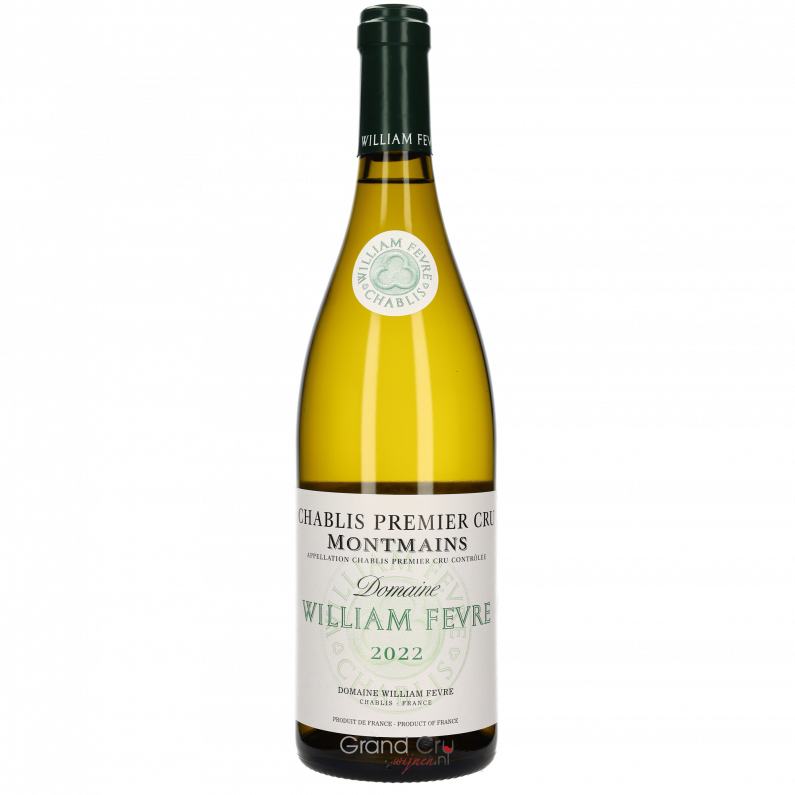
| Type of Wine | White |
|---|---|
| Country | France |
| Region | |
| Appellation | |
| Winery | |
| Vintage | 2022 |
| Grape | |
| Content (Alc) | 0.75 ltr (12.5%) |
| Drink window | 2026 - 2045 |
| Available as of | Nov 19, 2025 |
Ordering in bulk? Log in to request a quote
Out of Stock
Currently unavailable
Notify me when this product is back in stock
Notities
Foto
Proefnotities
Heb je deze wijn geproefd?
Bewaar je beoordeling en aantekeningen.
Bewaar je beoordeling en aantekeningen.
Heb je deze wijn geproefd?
Log in om je proefnotitie op te slaan.
Log in om je proefnotitie op te slaan.
InloggenHoe wil je je wijn beoordelen?
Max 5 MB. JPG, PNG, WebP.
Hoe smaakt het?
Klik op wat het beste past. Alles is optioneel.
Welke geuren en smaken herken je?
Klik op alles wat je herkent. Dit is optioneel.
Uiterlijk
Neus
Aroma's (neus)
Smaak
Smaken (mond)
Afdronk
Wijngegevens
Automatisch ingevuld vanuit productgegevens.
Persoonlijke gegevens
Domaine William Fèvre and its location within Chablis
Domaine William Fèvre has been one of the most respected Chablis producers for decades. The estate is located around the village of the same name in the northern part of Burgundy. The region is characterized by a cool climate with sunny days, cool nights, and soil composed of Kimmeridgian limestone and clay. This combination produces tension, freshness, and a distinctive minerality that makes the wines so beloved by both enthusiasts and professionals.
The estate covers approximately 78 hectares, divided between Chablis, Premier Cru, and Grand Cru plots. Under the leadership of Didier Séguier, the estate operates with a clear vision focused on precision, terroir, and minimal intervention. The winemaking process has been organic for many years. The 2022 vintage is even considered the penultimate step in official organic certification, although in practice, the estate has been working entirely according to organic principles for over sixteen years. Fèvre's style is recognizable by its depth, pure minerality, and balanced structure.
Recent developments underscore the estate's focus on the future. The acquisition by Domaines Barons de Rothschild (Lafite) is widely seen as a reinforcement of the course Fèvre has been pursuing for years. Both in the cellar and in the vineyards, the focus remains on precision and quality.
The Premier Cru Montmains and the unique characteristics of the terroir
Montmains is one of Chablis's most famous Premier Cru vineyards. The slopes, located in the southern part of the appellation, consist of calcareous clay, forcing the roots to penetrate deeply. The vineyard is spread across three sub-lieux dits, with the terroir offering variations in clay depth, structure, and drainage. The common denominator is a pronounced minerality that gives Montmains a character that is both taut and inviting.
The location allows for a long growing season, allowing the Chardonnay to ripen optimally without losing its freshness. This results in wines with a salty undertone, ripe fruit, and precise acidity. Montmains is often described by experts as being slightly gentler in its youth than some other Premier Cru parcels, yet with sufficient structure to develop beautifully.
Harvest, vinification and maturation of the 2022 Montmains
The 2022 vintage produced healthy and ripe grapes with an excellent balance of fruit and acidity. The growing season featured warm months combined with timely rain. This allowed the Chardonnay to fully develop without sacrificing any of its vibrancy. The harvest proceeded smoothly, with careful selection of the best fruit.
Vinification at Domaine William Fèvre focuses on freshness and depth. The grapes are gently pressed and fermented in a combination of stainless steel and reclaimed oak barrels. The barrels are neutral, eliminating woody aromas while still adding texture and complexity. Maturation lasts approximately ten to fifteen months, with some remaining on the lees for added roundness.
The 2022 Montmains is described as satiny and layered, with youthful tension and a somewhat compact structure. The wine has a clear mineral line and, according to experts, shows remarkable precision for this warm vintage. The profile is energetic and taut, indicating that this Montmains will age well.
Color, aroma and taste of the 2022 Montmains
In the glass, the wine displays a bright, light yellow color with a subtly glossy rim. The nose opens with green apple, pear, white flowers, and a hint of honey. The minerality is immediately present, giving the wine a cool, salty note.
On the palate, the wine is medium to full-bodied with a satiny texture and layered flavors. The minerality is supported by youthful fruit. The wine is still somewhat closed, yet firm and balanced, suggesting excellent aging potential well into 2040. The finish combines citrus, pear, and a crisp, chalky note that lingers.
According to experts, this vintage displays precisely the tension and freshness not readily found in all 2022 Chablis. The combination of purity, depth, and vibrant acidity makes it a wine that will offer great pleasure both now and in the years to come.
Would you like to order Domaine William Fèvre wines online?
If available, you'll find the official fact sheet and additional information about this fine wine in the "Attachments" tab. We'll automatically send you these when you order this wine. The wine is stored in our climate-controlled Wine Warehouse, and if you pick it up, you'll often receive a nice discount. You'll see your discount immediately when you select "Pick up" at the checkout page. We're located in Dordrecht, just off the A16 motorway with ample parking. Click here for our address. You can read full wine reviews from publications like Parker, Suckling, Vinous, and Wine Spectator.
Need advice on finding the perfect wine to pair with your dish? Click here for our exclusive Sommelier. Free for Grand Cru customers.
Wine and food pairings
- Steamed cod with lemon and samphire. The briny notes and the freshness of the wine enhance the delicate flavors of the cod.
- Scallops with cauliflower cream. The creamy texture complements the satiny mouthfeel and subtle minerality.
- Veal tenderloin with sage and a light cream sauce. The wine balances the dish and emphasizes the delicate spiciness.
- Grilled shrimp with garlic and parsley. The fresh fruit and tension complement the slightly sweet shrimp perfectly.
- Risotto with lemon, asparagus, and Parmesan. The acidity adds freshness, while the wine's structure supports the creamy risotto.
- Lobster with tarragon and a touch of butter. The wine brings purity, tension, and elegance to this rich dish.
| Available as of | Nov 19, 2025 |
|---|---|
| Packing information | Box |
| Type of Wine | White |
| Country | France |
| Region | Bourgogne |
| Appellation | Chablis |
| Winery | William Fevre |
| Grape | Chardonnay |
| Biological certified | No |
| Natural wine | No |
| Vegan | No |
| Vintage | 2022 |
| Drinking as of | 2026 |
| Drinking till | 2045 |
| Alcohol % | 12.5 |
| Alcohol free/low | No |
| Content | 0.75 ltr |
| Oak aging | Yes |
| Sparkling | No |
| Dessert wine | No |
| Closure | Cork |
| Parker rating | 92 |
| Vinous rating | 90 |
| Tasting Profiles | Bloemig, Complex, Droog, Fris, Fruitig, Licht, Mineraal, Strak, Wit fruit |
| Drink moments | Borrelen, Cadeau!, Iets te vieren, Indruk maken, Lekker luxe, Met vrienden, Open haard, Romantisch, Summer party, Terras |
| Sommy Pairing Beschrijving | Deze 2022 Montmains toont een helder profiel van groene appel, peer en citrus met een uitgesproken kalkachtige mineraliteit, satijnachtige textuur en frisse, precieze zuren die tegelijk wat rijp fruit en een ziltige ondertoon laten zien. Daardoor past hij uitstekend bij witte vis en schaaldieren omdat de mineraliteit en het zuur de delicate smaken versterken en vettere of romige bereidingen zoals coquilles met bloemkoolcrème, kreeft in boter of een risotto met citroen en asperges in balans houden zonder te overheersen. Bereidingen die extra goed werken zijn zacht stomen of kort pocheren van vis met citroen en zeekraal, gegrild of snel aangebakken schelpdier met een lichte knoflook-peterseliedressing en romige sauzen op basis van beurre blanc of een lichte roomsaus bij kalfsvlees. |
Parker
The Wine Advocate
RP 91+
Reviewed by:
William Kelley
Release Price:
NA
Drink Date:
2025 - 2040
The 2022 Chablis 1er Cru Montmains reveals aromas of green apple, pear, honey and white flowers, followed by a medium to full-bodied, satiny and layered palate that's taut, youthfully blocky and mineral. It shows good cellaring potential.
The 2022 crop is the penultimate vintage of organic conversion for the 78-hectare Domaine William Fèvre, though it's actually the 16th year the estate has been practicing organic. It's a terrific success, exhibiting tension and precision that isn't universally to be taken for granted in this Chablis vintage. Beyond the quality of the wines themselves, the big news at this address, which has been managed with sagacity and competence by Didier Séguier since 1999, is its acquisition by Domaines des Barons de Rothschild (Lafite). I'm sure Fèvre couldn't have found a better steward for the future.
Published: Mar 06, 2025
Lorem ipsum dolor sit amet, consectetur adipiscing elit. Sed do eiusmod tempor incididunt ut labore et dolore magna aliqua...
Vinous
(89-91)
Drinking Window
2025 - 2038
From: Where Art Thou Chablis? - Chablis 2021 & 2022 (Sep 2023)
The 2022 Chablis Montée de Tonnerre 1er Cru is more reticent on the nose and perhaps doesn't quite engage as the 2021 did last year. A bit bashful at the moment. The palate is well-balanced with a saline entry, though it feels strict and contained, without the flair demonstrated by the Les Lys at the moment. Has this got something up its sleeve? It's a bit too austere and reticent for my liking.
- By Neal Martin on July 2023
Lorem ipsum dolor sit amet, consectetur adipiscing elit. Sed do eiusmod tempor incididunt ut labore et dolore magna aliqua...
Exclusive Content
Sign in to unlock professional wine reviews from world-renowned critics
In the Mesozoic (middle time in earth's history) it was about as warm on the equator as it was on the poles. Ice sheets as we know them today did not exist and large parts of the world were below sea level. Marine life experienced tremendous growth during this geological time. Ammonites, squid-like animals in shells, were particularly abundant in the water.
Ammonites are now extinct and you can only find their limestone houses as fossils in places where the earth has revealed the resting place of these animals. Such as in the southern English coastal town of Kimmeridge - after which the soil type consisting of these fossil layers was named - and the French Chablis area. Fortunately, the chardonnay grape - or beaunois as it is locally called here - benefits greatly from calmer soil. No wonder north of the town of Chablis, where the limestone soils are most fertile, are the steep Grand Cru vineyards.
Here, moreover, the climatic conditions, thanks to a natural shelter from the cutting cold wind, are perfect. They are (from west to east) Les Bougerots, Les Preuses, Vaudésir, Les Grenouilles, Valmur, Les Clos and Blanchot.
The Premiers Cru's Fourchaume, Montée de Tonnerre, Mont de Milieu and Vaucoupin also benefit from almost the same favorable, south-westerly, sun-oriented location.
William Fèvre has always been one of the great advocates of genuine, authentic Chablis. He even wrote a book about it: Le vrai Chablis et les autres. However, in 1998 he sold his company and devoted himself entirely to his vineyards in Chile. However, the reputation and success of his Chablis company and the great wines that come from it would never end.
The new owner was not the first to be the best. It was Joseph Henriot of the champagne house of the same name and also owner of the Burgundy house Bouchard Père & Fils in Beaune, who took charge. Significant detail: since the takeover, the wines of the domain have continued to gain in class and sophistication every year!
Domaine William Fèvre is a wonderful company with an unlikely potential. It boasts over fifty hectares of its own vineyards, making it the largest private vineyard owner in all of Chablis. More important is the fact that of these vineyards, 12 hectares have the status of premier cru and fifteen and a half hectares that of grand cru. Those 15½ hectares of grands crus amount to fifteen percent of the total area. So Fèvre is like no other a reference for Chablis.
The entire production process is geared to translating the nuances in terroir into the wines. Therefore, the greatest care is taken in the condition of the fruit. This means, among other things, that returns are limited. Picking is done by hand, the selection is strict and the pressing is done with 'grape-friendly' pneumatic presses. Vinification is also aimed at a transparent, pure style.
For the education of the wines - usually between ten and fifteen months - (new) oak is used with the utmost restraint. To quote one of France's leading wine guides, Le Classement by Bettane & Desseauve: "Purs, droits, délicatement boisés et subtilements différenciés selons les origines du terroir ..."
The crus benefits from storage. They only show their true class within five to ten years. If they are given younger, they will benefit greatly from carving. They are excellent wines for the table: with fish and white meat and in the most powerful version, even for lobster in cream sauce.
Food Pairings
Deze 2022 Montmains toont een helder profiel van groene appel, peer en citrus met een uitgesproken kalkachtige mineraliteit, satijnachtige textuur en frisse, precieze zuren die tegelijk wat rijp fruit en een ziltige ondertoon laten zien. Daardoor past hij uitstekend bij witte vis en schaaldieren omdat de mineraliteit en het zuur de delicate smaken versterken en vettere of romige bereidingen zoals coquilles met bloemkoolcrème, kreeft in boter of een risotto met citroen en asperges in balans houden zonder te overheersen. Bereidingen die extra goed werken zijn zacht stomen of kort pocheren van vis met citroen en zeekraal, gegrild of snel aangebakken schelpdier met een lichte knoflook-peterseliedressing en romige sauzen op basis van beurre blanc of een lichte roomsaus bij kalfsvlees.
Click on a category to discover delicious recipes that pair perfectly with this wine.
Do you already have a dish in mind?
Let our AI sommelier help you find the ideal wine for your dish
Start the Sommy Wine Advice ToolDiscover Wine Trivia
Sign in to unlock fascinating facts about this wine and expand your knowledge.
Sign In