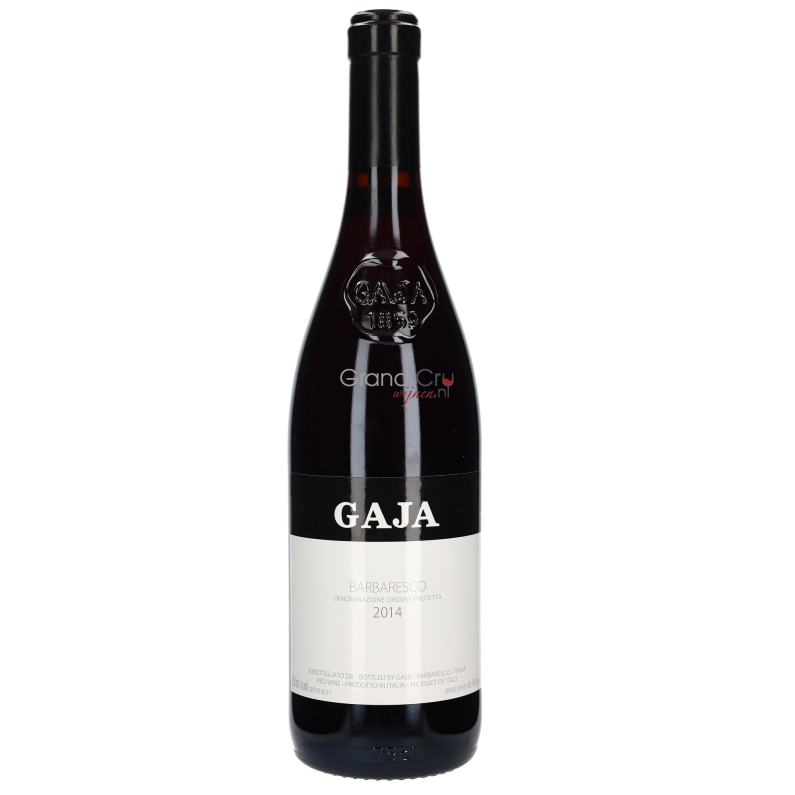
2014 Gaja Barbaresco
De specificaties zoals vermeld bij de wijn (o.a. wijnjaar) en in de titel zijn leidend en er kunnen geen rechten worden ontleend aan de afbeelding die wordt getoond. Lees meer in onze Frequenty asked questions
| Type of Wine | |
|---|---|
| Country | Italy |
| Region | |
| Appellation | |
| Winery | |
| Vintage | 2014 |
| Grape | |
| Content (Alc) | 0.75 ltr (14%) |
| Drink window | 2018 - 2038 |
Log in to request a custom quote.
In stock
6 items available
Description
Gaja Winery
Founded in 1859 in Barbaresco, Gaja is one of Italy's leading wineries. Its style focuses on precision, terroir expression, and long aging. The vineyards operate according to sustainable and increasingly biodynamic principles, focusing on healthy soils and low yields. In the cellar, Gaja combines traditional Piedmontese methods with modern insights, prioritizing purity, balance, and consistency.
More information about this winery can be found under the Winery tab.
Region, climate and location
This Barbaresco comes from the Langhe region of Piedmont, using grapes from various vineyards around Barbaresco and Treiso. The 2014 vintage had an exceptionally long and slow growing season, with a cool summer and a warm spell just before harvest. These conditions allowed for slow ripening, which is ideal for Nebbiolo, resulting in wines with aromatic depth, ripe fruit, and retained freshness.
Barbaresco within the domain
Gaja's Barbaresco is a blend of grapes from several top vineyards within the appellation. This wine forms the backbone of the estate and demonstrates each year how carefully selected plots can combine to create a complete and harmonious whole. In 2014, this resulted in a Barbaresco that closely resembles the Cru wines in intensity and structure, with a remarkable degree of cohesion and depth.
Vineyards
The grapes come from various plots with chalky soils and clay, which provides structure and aromatic complexity. Using multiple locations allows for a balance between ripeness, tension, and tannins. The low yields in 2014 contributed to extra concentration and a firm core.
Grape varieties and composition
The wine is made entirely from Nebbiolo. The selection focuses on grapes with ripe tannins, aromatic intensity, and sufficient natural acidity. In 2014, this resulted in a wine with ripe fruit and spicy depth, without overpowering sharpness or bitterness.
Harvest
The harvest followed a long growing season, with ripening arriving late. Thanks to the warm spell at the end of the season, the grapes were able to fully ripen, while the slow development created complexity and balance. Yields were significantly lower than average, contributing to concentration.
Vinification
Vinification was carried out with a focus on controlled extraction, appropriate for the vintage's concentration. Fermentation and maceration were aimed at preserving aromatic expression and developing structure, without harshness. This method aligns with the house's philosophy of prioritizing vintage and provenance.
Maturation
The wine was aged in a combination of large wooden barrels and smaller casks. This aging process ensures integration of tannins and preservation of freshness, while further refining the structure. The approach focuses on balance and aging potential, not just on early accessibility.
Color, smell and taste
The color is deep ruby red. The aroma reveals floral notes, ripe red and dark fruit, spices, licorice, and tobacco. On the palate, the wine is powerful and concentrated, with a dense structure and a clear tannic backbone. At the same time, the style remains energetic and precise, with lively acidity that adds tension and length. The finish is long, intense, and layered.
Development and drinking window
This Barbaresco is designed for aging and currently presents itself as compact and structured. Further bottle aging will enhance the nuance and complexity, further refining the tannins. The drinking window generally runs from around 2018 to 2035+, with potential for extended aging under good conditions.
Summary of professional reviews
Monica Larner awarded this wine 94 points, highlighting its ripe fruit expression, finesse, and lack of harshness, despite the challenging growing season. Antonio Galloni awarded it 96 points, praising its intensity, energy, and structure, emphasizing its excellent aging potential. Both reviewers see 2014 as a year of tension and focus.
The full review texts can be found in the Professional Reviews tab.
If available, you'll find the official fact sheet and additional information about this fine wine in the "Attachments" tab. We'll automatically send you this information when you order this wine. The wine is stored in our climate-controlled Wine Warehouse, and if you pick it up, you'll often receive a nice discount. You'll see your discount immediately when you select "Pick up" at the checkout page. We're located in Dordrecht, right next to the A16 motorway, with ample parking. Click here for our address.
You can read the full wine reviews from Parker, Suckling, Vinous, and Wine Spectator, among others. Need advice on finding the perfect wine to pair with your dish? Click here for our exclusive Sommelier. Free for Grand Cru customers.
Wine and food pairings
- Braised veal cheek with sage and celeriac, complemented well by the structure and depth of the wine.
- Roasted guinea fowl with mushrooms and thyme, matching the floral and spicy notes.
- Risotto with porcini and aged Parmesan, which enhances the earthy and umami elements.
- Venison with roasted carrot and a light herb sauce, which complements the tannin structure beautifully.
- Roasted beetroot with lentils and bay leaf, which respects the tension and freshness of the wine.
Specifications
| Type of Wine | Red |
|---|---|
| Country | Italy |
| Region | Piemonte |
| Appellation | Barbaresco |
| Icons | Icon Italy |
| Winery | Gaja |
| Grape | Nebbiolo |
| Biological certified | No |
| Natural wine | No |
| Vegan | No |
| Vintage | 2014 |
| Drinking as of | 2018 |
| Drinking till | 2038 |
| Alcohol % | 14 |
| Alcohol free/low | No |
| Content | 0.75 ltr |
| Oak aging | Yes |
| Sparkling | No |
| Dessert wine | No |
| Closure | Cork |
| Parker rating | 94 |
| Vinous rating | 96 |
Professional Reviews
Parker
Gaia Gaja tells me 2014 was one of the best vintages ever in Barbaresco, if not the best for her vineyards. She cites the prolonged growing season that continued at a slow rate during the cooler summer months only to speed up thanks to a heat spell at the very end, right before harvest. Nebbiolo loves slow maturity and a prolonged growth cycle: The 2014 vintage did indeed get off to an exceptionally slow start. The 2014 Barbaresco is not austere or astringent. Instead, it offers plump ripeness with rich fruit flavors backed by spice, licorice and tobacco. The wine offers good structure from the point of view of its tannins, yet there is no harshness or bitterness whatsoever.
I love writing my annual introduction to Gaja because there's always so much news to report. Last year, The Wine Advocate was the first to report that the estate's famously declassified wines, namely the Langhe Nebbiolo Costa Russi, Sorì Tildìn and Sorì San Lorenzo crus, had returned to the Barbaresco DOCG appellation. That tiny percentage of Barbera was removed and the wines are pure expressions of Nebbiolo from three distinct vineyards in the region. This year, we can add two more wines to full appellation status. Both from the Barolo region, Conteisa (from the Cerequio cru in La Morra) and Sperss (from the Marenca-Rivette vineyards in Serralunga d'Alba), have now officially returned to DOCG status. With the exception of the Bordeaux blend Darmagi, all of Gaja's top-end red wines are represented by either Barbaresco DOCG or Barolo DOCG status. I can confirm that the line of Barbaresco cru wines are being produced in the 2014 vintage and will be released next year. The other big news that broke during my trip to Etna, is that Angelo Gaja and his family have now invested on the Sicilian volcano. Gaja is joining forces with Alberto Aiello Graci of the Graci winery in Passopisciaro to make wine together. They bought 21 hectares of vines on the Southwest flank of the volcano. Gaja & Graci is big news for Etna, and is bigger news still for Gaja. The Piedmont powerhouse definitely knows how to grab those headlines.
Published: Jun 30, 2017
Lorem ipsum dolor sit amet, consectetur adipiscing elit. Sed do eiusmod tempor incididunt ut labore et dolore magna aliqua...
Vinous
96
Drinking Window
2024 - 2044
From: 2014 Barbaresco: An October Surprise (Oct 2017)
Gaja's 2014 Barbaresco is rich, super-dense, and inviting, with serious underpinnings of structure and the same classicism that made the 2013 so compelling. Dense and powerful in the glass, with explosive energy and tons of tannin, the 2014 is built for extended cellaring. Expressive floral and savory notes hover out of the glass in this super-expressive Barbaresco. This is one of the most tightly wound, intense versions of Gaja's Barbaresco I can remember tasting. Don't miss it.
- By Antonio Galloni on August 2017
The Gaja family's 2014 Barbarescos are more than worthy follow ups to the stellar 2013s. The 2014s also show a bit more stylistic cohesion throughout the range than was the case with the 2013s. Overall, the 2014s are defined by their energy, tension and brilliant personalities. As good as Gaja's cru wines are, the straight Barbaresco - which is a blend of many top sites - is as good or nearly as good as those wines. It is also much more accessibly priced, even if none of these wines can be defined as inexpensive. Sadly, yields are down 35% across the board for the 2014s.
Lorem ipsum dolor sit amet, consectetur adipiscing elit. Sed do eiusmod tempor incididunt ut labore et dolore magna aliqua...
Exclusive Content
Sign in to unlock professional wine reviews from world-renowned critics
Wijnhuis
The history of winery Gaja starts in 1859, the year in which Giovanni Gaja, a local grape grower in Barbaresco, Piemonte, founded a wine company under his own name. A generation later, it is Angelo, grandfather of the current owner, who continues to make wine with the same determination as his father. He is supported in this by Clotilde Rey with whom he marries in 1905. They teach their scion Giovanni named after his grandfather so that as a winemaker you should not make any concessions; nothing should be at the expense of the quality of the wine.
In 1961 Giovannis son Angelo works in the family business. After graduating as an economist from the University of Turin and graduating from the School of Viticulture & Oenology in Alba, the young Angelo left abroad for an internship at wine farms in Bordeaux, Burgundy, along the Rin and in California. Full of fresh ideas, he had now returned to his native Piemonte. When Angelo Gaja took over his parents' company in 1970, he asked his old classmate and winemaker Guido Rivella to assist him. Together they implement a number of revolutionary changes for the region. For example, they sometimes reduce yields per hectare by up to half the number of liters allowed, they experiment with vinification methods, the planting of new - both red and white - grape varieties and pioneering ripening techniques. The results are astonishing and Gaja conquers the world with his beautiful Barbaresco's - the company's flagship.
The nebbiolo grapes for the Barbaresco of Gaja traditionally came from different vineyards. Angelos' father, grandfather and his father did just that before. Although young Angelo would not end this tradition, he launched a new line of Barbaresco's from a single vineyard. Interest in these experimental single vinyard wines became more and more popular. As a proponent of a dynamic, purely quality-oriented wine culture, the brilliant winemaker decides from 1996 to completely break with what he considers to be a conservative and restrictive Italian designation of origin. Only his traditional Barbaresco is still on the market as a prestigious DOCG. He deliberately 'declassifies' all other red single vineyard wines into regional Langhe Nebbiolo DOC. These are the Sorì San Lorenzo, the Sorì Tildìn and the Costa Russi. Gajas Barolo Sperss also underwent the same name change. With the exception of the Dagromis Barolo DOCG, Sito Moresco and Conteisa de Langhe also bear DOC. Langhe DOC is also on the label of his white toppers from Piemonte, the Rossj-Bass, Alteni di Brassica and Gaia & Rey. After all, for Gaja the abbreviation does not guarantee good quality of a wine but the name of the producer.
Food
Binnenkort beschikbaar
Voor deze wijn worden binnenkort automatisch passende gerechten toegevoegd. In de tussentijd kunt u onze wijnadvies tool gebruiken.
Ontdek onze Wijnadvies ToolGaja Winery
Founded in 1859 in Barbaresco, Gaja is one of Italy's leading wineries. Its style focuses on precision, terroir expression, and long aging. The vineyards operate according to sustainable and increasingly biodynamic principles, focusing on healthy soils and low yields. In the cellar, Gaja combines traditional Piedmontese methods with modern insights, prioritizing purity, balance, and consistency.
More information about this winery can be found under the Winery tab.
Region, climate and location
This Barbaresco comes from the Langhe region of Piedmont, using grapes from various vineyards around Barbaresco and Treiso. The 2014 vintage had an exceptionally long and slow growing season, with a cool summer and a warm spell just before harvest. These conditions allowed for slow ripening, which is ideal for Nebbiolo, resulting in wines with aromatic depth, ripe fruit, and retained freshness.
Barbaresco within the domain
Gaja's Barbaresco is a blend of grapes from several top vineyards within the appellation. This wine forms the backbone of the estate and demonstrates each year how carefully selected plots can combine to create a complete and harmonious whole. In 2014, this resulted in a Barbaresco that closely resembles the Cru wines in intensity and structure, with a remarkable degree of cohesion and depth.
Vineyards
The grapes come from various plots with chalky soils and clay, which provides structure and aromatic complexity. Using multiple locations allows for a balance between ripeness, tension, and tannins. The low yields in 2014 contributed to extra concentration and a firm core.
Grape varieties and composition
The wine is made entirely from Nebbiolo. The selection focuses on grapes with ripe tannins, aromatic intensity, and sufficient natural acidity. In 2014, this resulted in a wine with ripe fruit and spicy depth, without overpowering sharpness or bitterness.
Harvest
The harvest followed a long growing season, with ripening arriving late. Thanks to the warm spell at the end of the season, the grapes were able to fully ripen, while the slow development created complexity and balance. Yields were significantly lower than average, contributing to concentration.
Vinification
Vinification was carried out with a focus on controlled extraction, appropriate for the vintage's concentration. Fermentation and maceration were aimed at preserving aromatic expression and developing structure, without harshness. This method aligns with the house's philosophy of prioritizing vintage and provenance.
Maturation
The wine was aged in a combination of large wooden barrels and smaller casks. This aging process ensures integration of tannins and preservation of freshness, while further refining the structure. The approach focuses on balance and aging potential, not just on early accessibility.
Color, smell and taste
The color is deep ruby red. The aroma reveals floral notes, ripe red and dark fruit, spices, licorice, and tobacco. On the palate, the wine is powerful and concentrated, with a dense structure and a clear tannic backbone. At the same time, the style remains energetic and precise, with lively acidity that adds tension and length. The finish is long, intense, and layered.
Development and drinking window
This Barbaresco is designed for aging and currently presents itself as compact and structured. Further bottle aging will enhance the nuance and complexity, further refining the tannins. The drinking window generally runs from around 2018 to 2035+, with potential for extended aging under good conditions.
Summary of professional reviews
Monica Larner awarded this wine 94 points, highlighting its ripe fruit expression, finesse, and lack of harshness, despite the challenging growing season. Antonio Galloni awarded it 96 points, praising its intensity, energy, and structure, emphasizing its excellent aging potential. Both reviewers see 2014 as a year of tension and focus.
The full review texts can be found in the Professional Reviews tab.
If available, you'll find the official fact sheet and additional information about this fine wine in the "Attachments" tab. We'll automatically send you this information when you order this wine. The wine is stored in our climate-controlled Wine Warehouse, and if you pick it up, you'll often receive a nice discount. You'll see your discount immediately when you select "Pick up" at the checkout page. We're located in Dordrecht, right next to the A16 motorway, with ample parking. Click here for our address.
You can read the full wine reviews from Parker, Suckling, Vinous, and Wine Spectator, among others. Need advice on finding the perfect wine to pair with your dish? Click here for our exclusive Sommelier. Free for Grand Cru customers.
Wine and food pairings
- Braised veal cheek with sage and celeriac, complemented well by the structure and depth of the wine.
- Roasted guinea fowl with mushrooms and thyme, matching the floral and spicy notes.
- Risotto with porcini and aged Parmesan, which enhances the earthy and umami elements.
- Venison with roasted carrot and a light herb sauce, which complements the tannin structure beautifully.
- Roasted beetroot with lentils and bay leaf, which respects the tension and freshness of the wine.
| Type of Wine | Red |
|---|---|
| Country | Italy |
| Region | Piemonte |
| Appellation | Barbaresco |
| Icons | Icon Italy |
| Winery | Gaja |
| Grape | Nebbiolo |
| Biological certified | No |
| Natural wine | No |
| Vegan | No |
| Vintage | 2014 |
| Drinking as of | 2018 |
| Drinking till | 2038 |
| Alcohol % | 14 |
| Alcohol free/low | No |
| Content | 0.75 ltr |
| Oak aging | Yes |
| Sparkling | No |
| Dessert wine | No |
| Closure | Cork |
| Parker rating | 94 |
| Vinous rating | 96 |
Parker
Gaia Gaja tells me 2014 was one of the best vintages ever in Barbaresco, if not the best for her vineyards. She cites the prolonged growing season that continued at a slow rate during the cooler summer months only to speed up thanks to a heat spell at the very end, right before harvest. Nebbiolo loves slow maturity and a prolonged growth cycle: The 2014 vintage did indeed get off to an exceptionally slow start. The 2014 Barbaresco is not austere or astringent. Instead, it offers plump ripeness with rich fruit flavors backed by spice, licorice and tobacco. The wine offers good structure from the point of view of its tannins, yet there is no harshness or bitterness whatsoever.
I love writing my annual introduction to Gaja because there's always so much news to report. Last year, The Wine Advocate was the first to report that the estate's famously declassified wines, namely the Langhe Nebbiolo Costa Russi, Sorì Tildìn and Sorì San Lorenzo crus, had returned to the Barbaresco DOCG appellation. That tiny percentage of Barbera was removed and the wines are pure expressions of Nebbiolo from three distinct vineyards in the region. This year, we can add two more wines to full appellation status. Both from the Barolo region, Conteisa (from the Cerequio cru in La Morra) and Sperss (from the Marenca-Rivette vineyards in Serralunga d'Alba), have now officially returned to DOCG status. With the exception of the Bordeaux blend Darmagi, all of Gaja's top-end red wines are represented by either Barbaresco DOCG or Barolo DOCG status. I can confirm that the line of Barbaresco cru wines are being produced in the 2014 vintage and will be released next year. The other big news that broke during my trip to Etna, is that Angelo Gaja and his family have now invested on the Sicilian volcano. Gaja is joining forces with Alberto Aiello Graci of the Graci winery in Passopisciaro to make wine together. They bought 21 hectares of vines on the Southwest flank of the volcano. Gaja & Graci is big news for Etna, and is bigger news still for Gaja. The Piedmont powerhouse definitely knows how to grab those headlines.
Published: Jun 30, 2017
Lorem ipsum dolor sit amet, consectetur adipiscing elit. Sed do eiusmod tempor incididunt ut labore et dolore magna aliqua...
Vinous
96
Drinking Window
2024 - 2044
From: 2014 Barbaresco: An October Surprise (Oct 2017)
Gaja's 2014 Barbaresco is rich, super-dense, and inviting, with serious underpinnings of structure and the same classicism that made the 2013 so compelling. Dense and powerful in the glass, with explosive energy and tons of tannin, the 2014 is built for extended cellaring. Expressive floral and savory notes hover out of the glass in this super-expressive Barbaresco. This is one of the most tightly wound, intense versions of Gaja's Barbaresco I can remember tasting. Don't miss it.
- By Antonio Galloni on August 2017
The Gaja family's 2014 Barbarescos are more than worthy follow ups to the stellar 2013s. The 2014s also show a bit more stylistic cohesion throughout the range than was the case with the 2013s. Overall, the 2014s are defined by their energy, tension and brilliant personalities. As good as Gaja's cru wines are, the straight Barbaresco - which is a blend of many top sites - is as good or nearly as good as those wines. It is also much more accessibly priced, even if none of these wines can be defined as inexpensive. Sadly, yields are down 35% across the board for the 2014s.
Lorem ipsum dolor sit amet, consectetur adipiscing elit. Sed do eiusmod tempor incididunt ut labore et dolore magna aliqua...
Exclusive Content
Sign in to unlock professional wine reviews from world-renowned critics
The history of winery Gaja starts in 1859, the year in which Giovanni Gaja, a local grape grower in Barbaresco, Piemonte, founded a wine company under his own name. A generation later, it is Angelo, grandfather of the current owner, who continues to make wine with the same determination as his father. He is supported in this by Clotilde Rey with whom he marries in 1905. They teach their scion Giovanni named after his grandfather so that as a winemaker you should not make any concessions; nothing should be at the expense of the quality of the wine.
In 1961 Giovannis son Angelo works in the family business. After graduating as an economist from the University of Turin and graduating from the School of Viticulture & Oenology in Alba, the young Angelo left abroad for an internship at wine farms in Bordeaux, Burgundy, along the Rin and in California. Full of fresh ideas, he had now returned to his native Piemonte. When Angelo Gaja took over his parents' company in 1970, he asked his old classmate and winemaker Guido Rivella to assist him. Together they implement a number of revolutionary changes for the region. For example, they sometimes reduce yields per hectare by up to half the number of liters allowed, they experiment with vinification methods, the planting of new - both red and white - grape varieties and pioneering ripening techniques. The results are astonishing and Gaja conquers the world with his beautiful Barbaresco's - the company's flagship.
The nebbiolo grapes for the Barbaresco of Gaja traditionally came from different vineyards. Angelos' father, grandfather and his father did just that before. Although young Angelo would not end this tradition, he launched a new line of Barbaresco's from a single vineyard. Interest in these experimental single vinyard wines became more and more popular. As a proponent of a dynamic, purely quality-oriented wine culture, the brilliant winemaker decides from 1996 to completely break with what he considers to be a conservative and restrictive Italian designation of origin. Only his traditional Barbaresco is still on the market as a prestigious DOCG. He deliberately 'declassifies' all other red single vineyard wines into regional Langhe Nebbiolo DOC. These are the Sorì San Lorenzo, the Sorì Tildìn and the Costa Russi. Gajas Barolo Sperss also underwent the same name change. With the exception of the Dagromis Barolo DOCG, Sito Moresco and Conteisa de Langhe also bear DOC. Langhe DOC is also on the label of his white toppers from Piemonte, the Rossj-Bass, Alteni di Brassica and Gaia & Rey. After all, for Gaja the abbreviation does not guarantee good quality of a wine but the name of the producer.
Binnenkort beschikbaar
Voor deze wijn worden binnenkort automatisch passende gerechten toegevoegd. In de tussentijd kunt u onze wijnadvies tool gebruiken.
Ontdek onze Wijnadvies ToolDiscover Wine Trivia
Sign in to unlock fascinating facts about this wine and expand your knowledge.
Sign InDescription
Gaja Winery
Founded in 1859 in Barbaresco, Gaja is one of Italy's leading wineries. Its style focuses on precision, terroir expression, and long aging. The vineyards operate according to sustainable and increasingly biodynamic principles, focusing on healthy soils and low yields. In the cellar, Gaja combines traditional Piedmontese methods with modern insights, prioritizing purity, balance, and consistency.
More information about this winery can be found under the Winery tab.
Region, climate and location
This Barbaresco comes from the Langhe region of Piedmont, using grapes from various vineyards around Barbaresco and Treiso. The 2014 vintage had an exceptionally long and slow growing season, with a cool summer and a warm spell just before harvest. These conditions allowed for slow ripening, which is ideal for Nebbiolo, resulting in wines with aromatic depth, ripe fruit, and retained freshness.
Barbaresco within the domain
Gaja's Barbaresco is a blend of grapes from several top vineyards within the appellation. This wine forms the backbone of the estate and demonstrates each year how carefully selected plots can combine to create a complete and harmonious whole. In 2014, this resulted in a Barbaresco that closely resembles the Cru wines in intensity and structure, with a remarkable degree of cohesion and depth.
Vineyards
The grapes come from various plots with chalky soils and clay, which provides structure and aromatic complexity. Using multiple locations allows for a balance between ripeness, tension, and tannins. The low yields in 2014 contributed to extra concentration and a firm core.
Grape varieties and composition
The wine is made entirely from Nebbiolo. The selection focuses on grapes with ripe tannins, aromatic intensity, and sufficient natural acidity. In 2014, this resulted in a wine with ripe fruit and spicy depth, without overpowering sharpness or bitterness.
Harvest
The harvest followed a long growing season, with ripening arriving late. Thanks to the warm spell at the end of the season, the grapes were able to fully ripen, while the slow development created complexity and balance. Yields were significantly lower than average, contributing to concentration.
Vinification
Vinification was carried out with a focus on controlled extraction, appropriate for the vintage's concentration. Fermentation and maceration were aimed at preserving aromatic expression and developing structure, without harshness. This method aligns with the house's philosophy of prioritizing vintage and provenance.
Maturation
The wine was aged in a combination of large wooden barrels and smaller casks. This aging process ensures integration of tannins and preservation of freshness, while further refining the structure. The approach focuses on balance and aging potential, not just on early accessibility.
Color, smell and taste
The color is deep ruby red. The aroma reveals floral notes, ripe red and dark fruit, spices, licorice, and tobacco. On the palate, the wine is powerful and concentrated, with a dense structure and a clear tannic backbone. At the same time, the style remains energetic and precise, with lively acidity that adds tension and length. The finish is long, intense, and layered.
Development and drinking window
This Barbaresco is designed for aging and currently presents itself as compact and structured. Further bottle aging will enhance the nuance and complexity, further refining the tannins. The drinking window generally runs from around 2018 to 2035+, with potential for extended aging under good conditions.
Summary of professional reviews
Monica Larner awarded this wine 94 points, highlighting its ripe fruit expression, finesse, and lack of harshness, despite the challenging growing season. Antonio Galloni awarded it 96 points, praising its intensity, energy, and structure, emphasizing its excellent aging potential. Both reviewers see 2014 as a year of tension and focus.
The full review texts can be found in the Professional Reviews tab.
If available, you'll find the official fact sheet and additional information about this fine wine in the "Attachments" tab. We'll automatically send you this information when you order this wine. The wine is stored in our climate-controlled Wine Warehouse, and if you pick it up, you'll often receive a nice discount. You'll see your discount immediately when you select "Pick up" at the checkout page. We're located in Dordrecht, right next to the A16 motorway, with ample parking. Click here for our address.
You can read the full wine reviews from Parker, Suckling, Vinous, and Wine Spectator, among others. Need advice on finding the perfect wine to pair with your dish? Click here for our exclusive Sommelier. Free for Grand Cru customers.
Wine and food pairings
- Braised veal cheek with sage and celeriac, complemented well by the structure and depth of the wine.
- Roasted guinea fowl with mushrooms and thyme, matching the floral and spicy notes.
- Risotto with porcini and aged Parmesan, which enhances the earthy and umami elements.
- Venison with roasted carrot and a light herb sauce, which complements the tannin structure beautifully.
- Roasted beetroot with lentils and bay leaf, which respects the tension and freshness of the wine.
Specifications
| Type of Wine | Red |
|---|---|
| Country | Italy |
| Region | Piemonte |
| Appellation | Barbaresco |
| Icons | Icon Italy |
| Winery | Gaja |
| Grape | Nebbiolo |
| Biological certified | No |
| Natural wine | No |
| Vegan | No |
| Vintage | 2014 |
| Drinking as of | 2018 |
| Drinking till | 2038 |
| Alcohol % | 14 |
| Alcohol free/low | No |
| Content | 0.75 ltr |
| Oak aging | Yes |
| Sparkling | No |
| Dessert wine | No |
| Closure | Cork |
| Parker rating | 94 |
| Vinous rating | 96 |
Professional Reviews
Parker
Gaia Gaja tells me 2014 was one of the best vintages ever in Barbaresco, if not the best for her vineyards. She cites the prolonged growing season that continued at a slow rate during the cooler summer months only to speed up thanks to a heat spell at the very end, right before harvest. Nebbiolo loves slow maturity and a prolonged growth cycle: The 2014 vintage did indeed get off to an exceptionally slow start. The 2014 Barbaresco is not austere or astringent. Instead, it offers plump ripeness with rich fruit flavors backed by spice, licorice and tobacco. The wine offers good structure from the point of view of its tannins, yet there is no harshness or bitterness whatsoever.
I love writing my annual introduction to Gaja because there's always so much news to report. Last year, The Wine Advocate was the first to report that the estate's famously declassified wines, namely the Langhe Nebbiolo Costa Russi, Sorì Tildìn and Sorì San Lorenzo crus, had returned to the Barbaresco DOCG appellation. That tiny percentage of Barbera was removed and the wines are pure expressions of Nebbiolo from three distinct vineyards in the region. This year, we can add two more wines to full appellation status. Both from the Barolo region, Conteisa (from the Cerequio cru in La Morra) and Sperss (from the Marenca-Rivette vineyards in Serralunga d'Alba), have now officially returned to DOCG status. With the exception of the Bordeaux blend Darmagi, all of Gaja's top-end red wines are represented by either Barbaresco DOCG or Barolo DOCG status. I can confirm that the line of Barbaresco cru wines are being produced in the 2014 vintage and will be released next year. The other big news that broke during my trip to Etna, is that Angelo Gaja and his family have now invested on the Sicilian volcano. Gaja is joining forces with Alberto Aiello Graci of the Graci winery in Passopisciaro to make wine together. They bought 21 hectares of vines on the Southwest flank of the volcano. Gaja & Graci is big news for Etna, and is bigger news still for Gaja. The Piedmont powerhouse definitely knows how to grab those headlines.
Published: Jun 30, 2017
Lorem ipsum dolor sit amet, consectetur adipiscing elit. Sed do eiusmod tempor incididunt ut labore et dolore magna aliqua...
Vinous
96
Drinking Window
2024 - 2044
From: 2014 Barbaresco: An October Surprise (Oct 2017)
Gaja's 2014 Barbaresco is rich, super-dense, and inviting, with serious underpinnings of structure and the same classicism that made the 2013 so compelling. Dense and powerful in the glass, with explosive energy and tons of tannin, the 2014 is built for extended cellaring. Expressive floral and savory notes hover out of the glass in this super-expressive Barbaresco. This is one of the most tightly wound, intense versions of Gaja's Barbaresco I can remember tasting. Don't miss it.
- By Antonio Galloni on August 2017
The Gaja family's 2014 Barbarescos are more than worthy follow ups to the stellar 2013s. The 2014s also show a bit more stylistic cohesion throughout the range than was the case with the 2013s. Overall, the 2014s are defined by their energy, tension and brilliant personalities. As good as Gaja's cru wines are, the straight Barbaresco - which is a blend of many top sites - is as good or nearly as good as those wines. It is also much more accessibly priced, even if none of these wines can be defined as inexpensive. Sadly, yields are down 35% across the board for the 2014s.
Lorem ipsum dolor sit amet, consectetur adipiscing elit. Sed do eiusmod tempor incididunt ut labore et dolore magna aliqua...
Exclusive Content
Sign in to unlock professional wine reviews from world-renowned critics
Wijnhuis
The history of winery Gaja starts in 1859, the year in which Giovanni Gaja, a local grape grower in Barbaresco, Piemonte, founded a wine company under his own name. A generation later, it is Angelo, grandfather of the current owner, who continues to make wine with the same determination as his father. He is supported in this by Clotilde Rey with whom he marries in 1905. They teach their scion Giovanni named after his grandfather so that as a winemaker you should not make any concessions; nothing should be at the expense of the quality of the wine.
In 1961 Giovannis son Angelo works in the family business. After graduating as an economist from the University of Turin and graduating from the School of Viticulture & Oenology in Alba, the young Angelo left abroad for an internship at wine farms in Bordeaux, Burgundy, along the Rin and in California. Full of fresh ideas, he had now returned to his native Piemonte. When Angelo Gaja took over his parents' company in 1970, he asked his old classmate and winemaker Guido Rivella to assist him. Together they implement a number of revolutionary changes for the region. For example, they sometimes reduce yields per hectare by up to half the number of liters allowed, they experiment with vinification methods, the planting of new - both red and white - grape varieties and pioneering ripening techniques. The results are astonishing and Gaja conquers the world with his beautiful Barbaresco's - the company's flagship.
The nebbiolo grapes for the Barbaresco of Gaja traditionally came from different vineyards. Angelos' father, grandfather and his father did just that before. Although young Angelo would not end this tradition, he launched a new line of Barbaresco's from a single vineyard. Interest in these experimental single vinyard wines became more and more popular. As a proponent of a dynamic, purely quality-oriented wine culture, the brilliant winemaker decides from 1996 to completely break with what he considers to be a conservative and restrictive Italian designation of origin. Only his traditional Barbaresco is still on the market as a prestigious DOCG. He deliberately 'declassifies' all other red single vineyard wines into regional Langhe Nebbiolo DOC. These are the Sorì San Lorenzo, the Sorì Tildìn and the Costa Russi. Gajas Barolo Sperss also underwent the same name change. With the exception of the Dagromis Barolo DOCG, Sito Moresco and Conteisa de Langhe also bear DOC. Langhe DOC is also on the label of his white toppers from Piemonte, the Rossj-Bass, Alteni di Brassica and Gaia & Rey. After all, for Gaja the abbreviation does not guarantee good quality of a wine but the name of the producer.
Food
Binnenkort beschikbaar
Voor deze wijn worden binnenkort automatisch passende gerechten toegevoegd. In de tussentijd kunt u onze wijnadvies tool gebruiken.
Ontdek onze Wijnadvies ToolTrivia
Discover Wine Trivia
Sign in to unlock fascinating facts about this wine and expand your knowledge.
Sign In