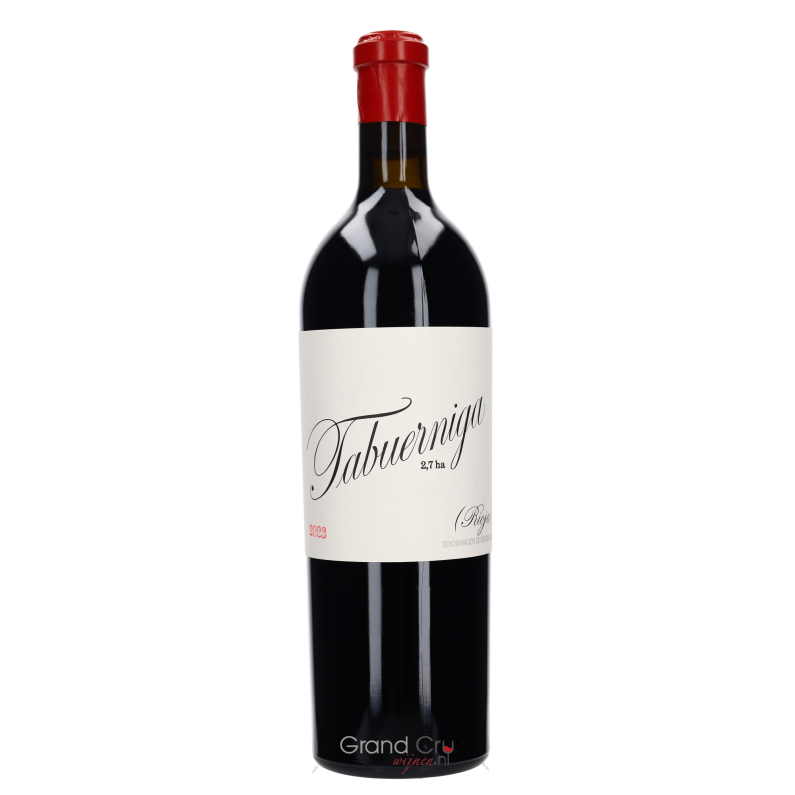
2023 Telmo Rodriguez Tabuerniga

The vintage may differ from the image shown
biologisch
95.95

Ordering in bulk? Log in to request a quote

Low Stock

Only 1 left

Order before 17:00, shipped today
Sustainably packaged - CO2-neutral delivery
Enjoy now or cellar until 2045
Hoog gewaardeerd door professionals
Serve at 16-18°C

Heb je deze wijn geproefd?

Log in om je proefnotitie op te slaan.

Inloggen

The 2023 Telmo Rodriguez Tabuérniga is one of the most characterful terroir wines in the Telmo Rodríguez portfolio. Hailing from a remote historic valley near Labastida in Rioja Alavesa, this wine reveals a very different side of Rioja from the powerful and ripe style often associated with the region. Tabuérniga revolves around altitude, tension, freshness, and terroir expression. The result is a wine with an understated character, yet with impressive depth and elegance.

A hidden valley in the heart of Rioja Alavesa

Tabuérniga originates from a unique location near the historic village of Labastida, where viticulture has been practiced for over 1,300 years. The valley is small, steep, and isolated, surrounded by old terraced vineyards. Among the vineyards, medieval wine presses carved out of the rocks are still visible, silent witnesses to centuries of winemaking history.

Part of these historic terraces was abandoned for years until Telmo Rodríguez and his team began restoring the old vineyards. Today, Tabuérniga is one of the most distinctive terroirs of Rioja Alavesa and serves as a prime example of Telmo Rodríguez's philosophy: restoring and protecting unique historic vineyards.

Elevated terraces and a unique terroir expression

The vineyards are situated at altitudes between 540 and 630 meters above sea level. Due to this location, the grapes benefit from cool nights and a longer growing season, ensuring that aromas, acidity, and structure are optimally preserved.

The narrow terraces are cultivated organically and maintained with great respect for traditional viticulture. In this enclosed valley, grape varieties with a shorter vegetative cycle feel particularly at home. This results in a wine that focuses less on richness and more on precision, tension, and elegance.

Tabuérniga is known for its austere and restrained style, where complexity and finesse take center stage. It is a wine that unfolds gradually, continually revealing new layers.

Volume 2023

After a winter and spring with limited rainfall, rain in June restored the necessary water reserves to the soil. This proved essential for healthy fruit set and the balanced development of the vines.

The summer was subsequently characterized by warm and dry conditions, which accelerated ripening. However, rain in September ensured a gradual conclusion to the growing season and helped the grapes retain their freshness and aromatic precision. The Graciano grapes, in particular, benefited from these conditions and developed an impressive structure and complexity.

The harvest began on September 26, just a few days later than in 2022. Ultimately, only 1,966 bottles were produced, making this wine particularly scarce.

Scent, taste and style

The 2023 Tabuérniga distinguishes itself through its refined and classic style. The aroma is dominated by red berries, wild herbs, floral notes, and subtle earthy nuances. As the wine opens up, more layers of spices, minerality, and fine oak influences emerge.

On the palate, the wine displays a striking combination of tension and depth. The structure is refined, with lively acidity and a core of pure fruit supported by elegant tannins. The higher elevation of the vineyards lends the wine freshness and precision, while the historic terraces provide additional complexity.

What makes Tabuérniga special is its restrained power. This is not a Rioja that impresses through concentration alone, but through balance, finesse, and terroir expression. The finish is long, mineral, and very refined.

Tabuérniga is one of the most terroir-driven wines of Rioja. The combination of a historic valley, high-altitude terraces, organic viticulture, and the vision of Telmo Rodríguez results in a wine that showcases the authentic side of Rioja Alavesa. Moreover, with a production of only 1,966 bottles, this is a wine with limited availability.

At Grandcruwijnen, you buy exclusive top Spanish wines directly from specialized importers. All wines are stored under optimal conditions and shipped with care, or can be picked up at our store in Dordrecht.

Packing information Box
Type of Wine Red
Country Spain
Region Rioja
Appellation Rioja
Winery Telmo Rodriguez
Grape Tempranillo
Biological certified Yes
Natural wine No
Vegan No
Vintage 2023
Drinking as of 2025
Drinking till 2045
Alcohol % 14
Alcohol free/low No
Content 0.75 ltr
Oak aging Yes
Sparkling No
Dessert wine No
Closure Cork
Parker rating 98
James Suckling rating 98
Tasting Profiles Complex, Droog, Houtgerijpt, Krachtig, Kruidig, Rood fruit, Tannines, Vol
Drink moments Indruk maken, Lekker luxe, Open haard

Parker

98

James Suckling

98

Winemaker Telmo Rodriguez is labeled as one of the young lions of the Spanish wine industry. He studied at the University of Bordeaux and later in the Rhône with the famous August Clape. He was the winemaker of La Granja Senora De Remelluri, his father's bodega in Rioja. He left there to become what some would call a flying winemaker. However, Telmo prefers to call itself a 'driving winemaker'. he lives in Madrid and drives his car to the areas where he makes wine. In a short time his wines have found a place on the international playing field. One example: in Tom Stevenson's Wine Report 2008, Telmo is included among the top 10 producers from Spain. We once again spoke extensively with Telmo Rodriguez. That is always a pleasure. If you sit down with him you always learn something or he gives food for thought. What makes this 'conscience of the Spanish wine world' so special? When Telmo completed his studies in Bordeaux and then had internships with people like Chave (Hermitage), Clape (Cornas) and Dürrbach (Trévallon) he came back to Spain. There he saw other Spaniards who had studied in France bringing French grape varieties and customs to Spain. For example, there was more and more wire guidance, while the Spanish system had always been free-standing sticks. Telmo concluded that he wanted to focus on the old qualities of Spain such as freestanding sticks, indigenous grape varieties and field blends. In addition, he was the first in Spain to introduce modern labels and he opposes the rigid Spanish wine laws.

Free standing sticks
Spain used to be a country of bush vines: the sticks were so far apart per area and per vineyard that they could each get enough water. If you place your sticks far apart with wire articulation, the stick will grow far and become much too large. With wire articulation, you therefore need many more sticks per hectare. However, the problem is that there is not enough water for this and you therefore have to irrigate, in areas that often already suffer from a shortage of water. In addition, the grapes hang more in the shade with free-standing sticks, which gives less chance of 'burning' and leads to less stewed fruit and fresher acids. The only downside to free-standing canes is that more manual work is involved in vineyard management and harvesting. Telmo works almost exclusively with bush vines.

Native grape varieties
It was clear to Telmo that there are so many good indigenous varieties in Spain that importing 'the big five' (Chardonnay, Sauvignon Blanc, Merlot, Cabernet and Syrah) from France was not necessary at all. He was one of the first to produce good Rueda from Verdejo and Viura, he embraced Mencia and Godello in Valdeorras, Monastrell in Alicante, Moscatel in Malaga, Garnacha in Cebreros…. In the mid-1990s he was still considered crazy with this philosophy, but now everyone is following him.

Field blends
There used to be many vineyards in Spain with various grape varieties mixed together, also called 'field blends'. It is often argued against field blends that the varieties (that are picked together) are not all ripe at the same time. It speaks for the fact that diversity and disease resistance increase and that it promotes complexity. Telmo now has two vineyards with field blends in production. In Rioja he makes it Las Beatas (named after the vineyard, first vintage awarded with 97 points by Parker) and in Valdeorras Las Caborcas. Beautiful, original wines!

Spanish wine laws
Telmo was the first to remove the word Reserva from a Rioja in 1995. In his words: 'I ask my wines how long they want to stay in the wood'. One year grapes can easily handle a 12-month aging in wood, but not in another year. There was consternation about Las Beatas: the Consecho initially did not want to approve the wine made with a field blend as Rioja… while there was a time when all Rioja was made that way! Consecho did not push this to the extreme and ultimately fortunate for them, given the enormously high international appreciation.

🍷
✨

Coming soon

Matching dishes will be added automatically for this wine soon. In the meantime, you can use our wine advice tool.

Discover our Wine Advice Tool