

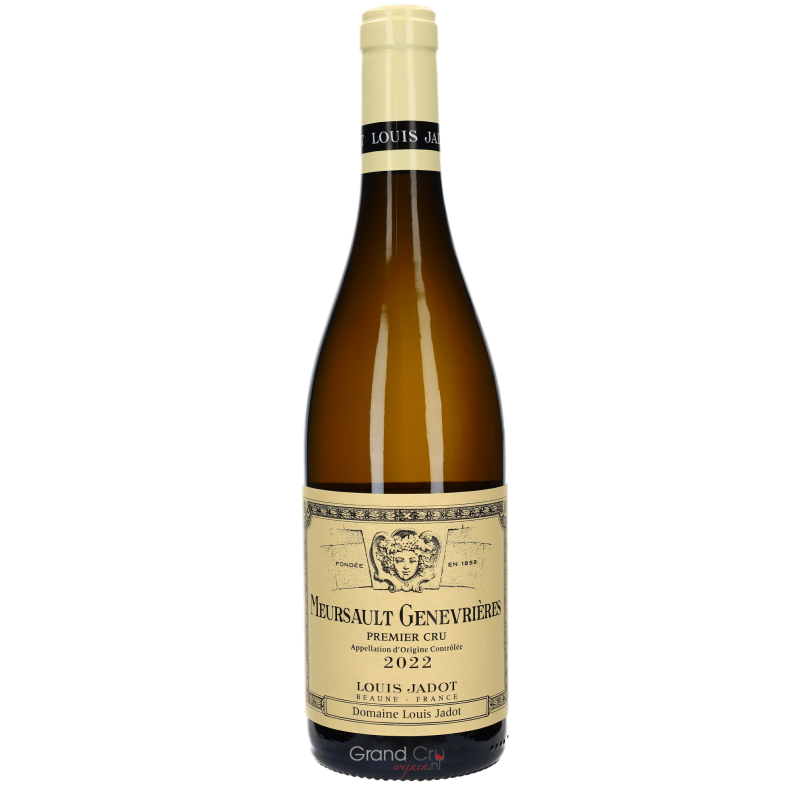
2022 Louis Jadot Meursault 1er Cru Genevrières
| Type of Wine | |
|---|---|
| Country | France |
| Region | |
| Appellation | |
| Winery | |
| Vintage | 2022 |
| Grape | |
| Content (Alc) | Standard (0.75 ltr) (13%) |
| Drink window | 2026 - 2040 |
Ordering in bulk? Log in to request a quote
Low Stock
Only 1 left
Notities
Foto
Proefnotities
Heb je deze wijn geproefd?
Bewaar je beoordeling en aantekeningen.
Bewaar je beoordeling en aantekeningen.
Heb je deze wijn geproefd?
Log in om je proefnotitie op te slaan.
Log in om je proefnotitie op te slaan.
InloggenHoe wil je je wijn beoordelen?
Max 5 MB. JPG, PNG, WebP.
Hoe smaakt het?
Klik op wat het beste past. Alles is optioneel.
Welke geuren en smaken herken je?
Klik op alles wat je herkent. Dit is optioneel.
Uiterlijk
Neus
Aroma's (neus)
Smaak
Smaken (mond)
Afdronk
Wijngegevens
Automatisch ingevuld vanuit productgegevens.
Persoonlijke gegevens
Louis Jadot and the Premier Cru vineyard Genevrières
Louis Jadot is one of the most established names in Burgundy and has been working for generations with a focus on terroir, precision, and classic vinification. The estate combines modern techniques with respect for tradition. Genevrières is one of Meursault's most refined Premier Crus and is known for wines with finesse, structure, and subtle depth. Under the Winery tab, you will find detailed information about the estate and its philosophy.
The Genevrières terroir features chalky soils with fine marl, ideal for Chardonnay with tension and aromatic richness. Its southeastern exposure ensures balanced ripening and gives the wines a distinctive combination of creaminess and crisp precision.
Grapes, harvest and vinification of the 2022 Genevrières
The 2022 vintage is made entirely from Chardonnay. The growing season was warm and dry, with very little rain and exceptionally early ripening. Thanks to some crucial rains in June and late August, the growth remained balanced, allowing the grapes to develop their concentration and aromatic complexity without excessive alcohol.
The grapes are harvested by hand and carefully selected. In the cellar, Jadot works with a combination of classic pints and larger foudres and 500-liter barrels. These larger sizes enhance the freshness of Chardonnay in warmer years and add more nuance to the texture. Malolactic fermentation is carefully managed to retain a small amount of malic acid, which gives the wine added tension and length.
Color, aroma and taste of the 2022 Meursault Genevrières
The color is bright light gold. The aroma reveals notes of ripe pear, mint, beeswax, and light puff pastry. The combination of aromatic freshness and soft creaminess is immediately noticeable.
On the palate, the wine is medium to full-bodied. The texture is satiny and layered, with concentration and depth without being heavy. The palate offers a blend of ripe citrus, peach, subtle spices, and mineral tension. The finish is long and precise, with a hint of salty freshness and a surprising steely note that contrasts beautifully with the creamy notes. The balance between energy and smoothness makes this vintage particularly appealing.
Storage potential and development
The 2022 Genevrières is already expressive and approachable, yet has sufficient structure and concentration to develop beautifully. Expect the wine to gain additional complexity between 2026 and at least 2040, with greater depth, honeyed notes, and refined tension. The warm vintage adds charm, while the controlled acidity and texture ensure long aging.
Would you like to order Louis Jadot wines online?
If available, you'll find the official fact sheet and additional information about this fine wine in the "Attachments" tab. We'll automatically send you these when you order this wine. The wine is stored in our climate-controlled Wine Warehouse, and if you pick it up, you'll often receive a nice discount. You'll see your discount immediately when you select "Pick up" at the checkout page. We're located in Dordrecht, just off the A16 motorway with ample parking. Click here for our address. You can read full wine reviews from publications like Parker, Suckling, Vinous, and Wine Spectator.
Need advice on finding the perfect wine to pair with your dish? Click here for our exclusive Sommelier. Free for Grand Cru customers.
Wine and food pairings for the 2022 Meursault Genevrières
Grilled scallops with lemon butter and chives
The creamy texture of the wine complements beautifully the soft sweetness of the scallops and the fresh citrus accents.
Cod with beurre blanc and fresh herbs
The elegant fat content and mineral tension of the wine support the creamy sauce and mild flavour of the fish.
Pasta with lobster, garlic and light cream sauce
The wine's rich, satin texture balances the creaminess of the dish and enhances the refined shellfish aromas.
Mushroom risotto with a hint of lemon
The combination of earthiness and fresh tension in the wine goes well with the soft creaminess of risotto.
Chicken supreme with tarragon and creamy sauce
The spicy elements and soft structure of the dish are supported by the round notes and fresh base of the wine.
Roasted cauliflower with hazelnut and brown butter
The nutty aromas and light caramel notes match the creamy style of the Genevrières.
| Type of Wine | Red |
|---|---|
| Country | France |
| Region | Bourgogne |
| Appellation | Meursault |
| Winery | Louis Jadot |
| Grape | Chardonnay |
| Biological certified | No |
| Natural wine | No |
| Vegan | No |
| Vintage | 2022 |
| Drinking as of | 2026 |
| Drinking till | 2040 |
| Alcohol % | 13 |
| Alcohol free/low | No |
| Content | Standard (0.75 ltr) |
| Oak aging | Yes |
| Sparkling | No |
| Dessert wine | No |
| Closure | Cork |
| Parker rating | 94 |
| Vinous rating | 93 |
| Tasting Profiles | Complex, Droog, Fruitig, Houtgerijpt, Mineraal, Rijk, Tannines, Vol, Wit fruit |
| Drink moments | Iets te vieren, Lekker luxe, Met vrienden, Open haard, Romantisch, Terras |
| Sommy Pairing Beschrijving | Deze Meursault Genevrières 2022 toont rijpe peer en perzik, frisse citrusaccenten en een subtiele bijenwas- en kruidenlaag op een satijnzachte, romige structuur met heldere minerale spanning en een lange, precieze finale. Daardoor vult hij rijkere bereidingen zoals coquilles met citroenboter, kabeljauw met beurre blanc of kreeftenpasta aan door de romigheid te dragen en tegelijk de zuren en mineraliteit te bieden die vet en saus in balans brengen; ook bij kip suprême met dragon, paddenstoelenrisotto of geroosterde bloemkool met bruine boter en hazelnoot werkt hij uitstekend. Kies voor lichte grill of snel bakken van schelp- en schaaldieren met een zure boterjus, zachte roomsausjes bij vis of gevogelte en een scheutje citroen of verse kruiden in risotto om de verfijning van de wijn maximaal te laten spreken. |
Parker
The Wine Advocate
RP (92-94)
Reviewed by:
William Kelley
Release Price:
NA
Drink Date:
N/A
Another high point in the portfolio is the 2022 Meursault 1er Cru Genevrières (Domaine Louis Jadot), a beautiful wine that delivers aromas of minty pear, beeswax and buttery pastry, followed by a medium to full-bodied, satiny and suave palate that's layered, concentrated and penetrating.
Winemaker Frédéric Barnier and his team have produced another strong portfolio chez Jadot, with a relatively abundant crop of charming, pure and demonstrative wines, with alcohol back in more normal territory after the highs of 2018, 2019 and 2020. As I've written before, in the cellar, foudres and 500-liter barrels now complement classic 228-liter pièces, a further evolution adapting to warmer, riper vintages. A cold room also helps chill down any fruit that's too warm when it enters the winery. 2022 is also the second vintage of organic conversion for the Domaine Louis Jadot and the Domaine Gagey.
Published: Jan 18, 2024
Lorem ipsum dolor sit amet, consectetur adipiscing elit. Sed do eiusmod tempor incididunt ut labore et dolore magna aliqua...
Vinous
(91-93)
Drinking Window
2026 - 2040
From: Now, For My Latest Trick: Burgundy 2022 (Jan 2024)
The 2022 Meursault Les Genevrières 1er Cru came from a more recent barrel than others, so the wood influence is a little more evident, though simpatico with the fruit concentration. The palate is well-balanced with a sapid entry. Not a complex Genevrières, though there is a surprising steeliness that you would not expect from such a growing season. Impressive length…I feel that this Meursault will have more to give with bottle age.
- By Neal Martin on October 2023
As I have done for several years, I conducted an unexpurgated tasting of Jadot, broaching comprehensive whites and reds over two-morning sessions with head winemaker Frédéric Barnier.
“The 2022 vintage was one of the warmest in Burgundy. On average, it was warmer than 1947 or 2003, so it’s in the top two or three ever. It was also one of the driest, below the average quantity of rainfall every month except one, which is key to explaining the season. That was due to three or four days of rain at the end of June. It was fundamental because, without it, the vines would have been completely stressed and blocked, probably losing a large part of the fruit. Water was really the challenge. The vines adapted to the heat, especially since it came at the beginning of the season. Between early July to around August 20, there was no rain. Zero. So, the capacity of the vines to withstand this lack of water derives from the rain in June: 80mm in the Côte de Beaune and a maximum of 150mm in the north of the Côte de Nuits. Also, it fell as two or three storms instead of one, which is important because water could penetrate the subsoil.”
“The second key moment is the change of weather at the end of August. We were worried for the young vines in terms of lack of water and saw some yellowing of leaves, and the berries became a little shriveled, which are bad signs because it means the vines are trying to survive instead of focusing [their energy] on the fruit. The forecast was for some rain, so it was a kind of bet. If there had been no water, then it would have been a problem, but some rain would restart the vines. We had around 10-20mm, which is not a lot, so it did not alter the volume but changed the ambiance, and we saw the beginning of warm days and fresh nights, which helped the vines to regain the classic ripening cycle. We could see the ripeness arriving and it moderated the level of alcohol, between 13.0% to 13.5%. The sanitary conditions were fine because of the dry conditions with just a bit of oïdium. We started the harvest for the whites at the end of August. The 2022 vintage has one of the lowest acidities, less than the previous two vintages, which is challenging for the whites, but the lower alcohol means you don’t feel it. So, I prefer it to the 2019 whites. We did not acidify, though we stopped the malolactic fermentation earlier than other vintages. In 2022, we kept 1g/L of malic acid; in 2020, it was 0.5g/L of malic acid. With regard to the reds, we are experimenting with stem addition as full clusters. I do not want to shape the wine in terms of style, so the maximum I have used is 30%.”
Lorem ipsum dolor sit amet, consectetur adipiscing elit. Sed do eiusmod tempor incididunt ut labore et dolore magna aliqua...
Exclusive Content
Sign in to unlock professional wine reviews from world-renowned critics
Louis Jadot Cote de Beaune
In contrast to the Côte de Nuits - where almost exclusively red Burgundy is made - in the Côte de Beaune mostly white, but also some red wines are made. Both wine regions are part of the Côte d 'Or and are located east of the Hautes Côtes and are separated by wine city Beaune.
The most beautiful red Burgundies of the Côte d 'Or are made of pinot noir from marl-rich plots along a long low-lying hillside. The white grape groves can be found where the bottom of the 'Gold Coast' consists largely of limestone.
Both the vineyards of the Côte de Nuits and - Beaune are oriented east and southeast, and are therefore reasonably protected from the wet west wind.
The recent history of Burgundy house Louis Jadot started in 1970 when oenologist Jacques Lardière offered his services to André Gagey, the then general manager and father of the current - eponymous - manager of the company. As the chief man of the technical staff, the maître de chais, he is responsible for the more than 140 hectares of vineyards and the vinification process of some 150 wines from the Chablis, Côte d'Or, Côte Chalonnaise, Maconnais and Beaujolais. His approach is unique in the wine world at the time: he lets nature take its full course.
The quirky winemaker shuns the use of herbicides, pesticides, fertilizers and any other crop stimulants or protectants. Because, he believes, a healthy soil gives strong grapes and therefore good wines. In fact, Lardière is so confident in nature that he does not work with industrial yeasts, he finds complicated chemical analyzes in laboratories superfluous, and peeling and fermentation take place without temperature-influencing equipment. Only limited pruning and a 'green harvest' are allowed.
The grapes for the wines of Louis Jadot are always harvested manually. This prevents over- and unripe fruits from ending up in the vinification process. In addition, the grape pickers use small boxes when harvesting so that the bunches are not bruised or damaged prematurely. Grapes that nevertheless escape this attention are still removed from the selection table or table de tri.
The starting point for the vinification of Jadot wines is that each appellation has its unique smell and taste. The terroir so famous in Burgundy must always be recognizable in the wine. As a result, there is no such thing as general as a Jadot "wine style": each type of Louis Jadot wine has its own individual character.
Deze Meursault Genevrières 2022 toont rijpe peer en perzik, frisse citrusaccenten en een subtiele bijenwas- en kruidenlaag op een satijnzachte, romige structuur met heldere minerale spanning en een lange, precieze finale. Daardoor vult hij rijkere bereidingen zoals coquilles met citroenboter, kabeljauw met beurre blanc of kreeftenpasta aan door de romigheid te dragen en tegelijk de zuren en mineraliteit te bieden die vet en saus in balans brengen; ook bij kip suprême met dragon, paddenstoelenrisotto of geroosterde bloemkool met bruine boter en hazelnoot werkt hij uitstekend. Kies voor lichte grill of snel bakken van schelp- en schaaldieren met een zure boterjus, zachte roomsausjes bij vis of gevogelte en een scheutje citroen of verse kruiden in risotto om de verfijning van de wijn maximaal te laten spreken.
Click on a category to discover delicious recipes that pair perfectly with this wine.
Do you already have a dish in mind?
Let our AI sommelier help you find the ideal wine for your dish
Start the Sommy Wine Advice ToolDiscover Wine Trivia
Sign in to unlock fascinating facts about this wine and expand your knowledge.
Sign In