

2025 Sadie Family Skerpioen
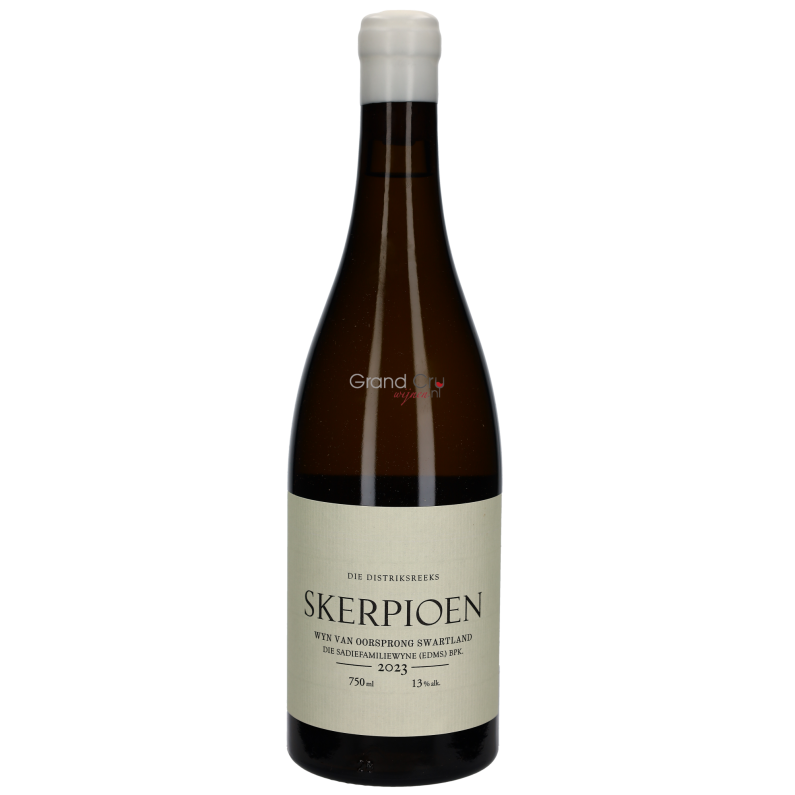
De specificaties zoals vermeld bij de wijn (o.a. wijnjaar) en in de titel zijn leidend en er kunnen geen rechten worden ontleend aan de afbeelding die wordt getoond. Lees meer in onze Frequenty asked questions
| Type of Wine | White |
|---|---|
| Country | |
| Region | |
| Appellation | Swartland |
| Winery | |
| Vintage | 2025 |
| Grape | , |
| Content (Alc) | Standard (0.75 ltr) (13.5%) |
| Drink window | 2027 - 2042 |
| Available as of | Sep 24, 2026 |
Ordering in bulk? Log in to request a quote
Notities
Foto
Proefnotities
Heb je deze wijn geproefd?
Bewaar je beoordeling en aantekeningen.
Bewaar je beoordeling en aantekeningen.
Heb je deze wijn geproefd?
Log in om je proefnotitie op te slaan.
Log in om je proefnotitie op te slaan.
InloggenHoe wil je je wijn beoordelen?
Max 5 MB. JPG, PNG, WebP.
Hoe smaakt het?
Klik op wat het beste past. Alles is optioneel.
Welke geuren en smaken herken je?
Klik op alles wat je herkent. Dit is optioneel.
Uiterlijk
Neus
Aroma's (neus)
Smaak
Smaken (mond)
Afdronk
Wijngegevens
Automatisch ingevuld vanuit productgegevens.
Persoonlijke gegevens
Skerpioen is a wine from a truly unique location, halfway between Dwarskersbos and Elands Bay on the west coast. One of the most astonishing aspects of this location is the chalky soil. It is also one of the coolest parts of the Swartland region, situated just 2km from the Atlantic Ocean, but it is also a very dry area with an average annual rainfall of around 300mm. This location experiences some of the strongest southeasterly winds, and the old vines look almost battered after years of being battered by the wind and blowing sand.
The Skerpioen is a blend of Chenin Blanc / Steen (South African synonym) and Palomino / Vaalblaar (South African synonym). After harvest, the grapes are placed in a cold room to lower the temperature, as average temperatures are often 35 degrees Celsius or higher—and pressing warm grapes brings its own set of challenges. The whole bunch is then pressed, a process that takes about 3 hours and allows for some settling of the juice in the receiving tank. The juice is then transferred to two old barrels for fermentation. Natural fermentation can sometimes last 5 days or longer. Fermentation can last 1 to 6 months and sometimes doesn't finish until the following spring, when malolactic fermentation is often also complete. The wine remains in barrel on the lees for the first 12 months, and we bottle from the lees.
The Skerpioen emerges in the aromas with volumes of fruit and notes of lime, citrus, and chamomile. This wine's characteristic briny qualities, its salty flavor, and minerality are once again prominent. The salinity of this wine is a textbook example of the vineyard's location and terroir. The tannins are firm and the acidity is fresh, and we recommend buying some oysters soon! This wine is better to appreciate early on than most of Sadie's other wines.
FACT: In the "Attachments" tab, you'll find the official fact sheet for this fine wine. We'll automatically send it to you when you order it. The wine is stored in our climate-controlled Wine Warehouse, and if you pick it up, you'll often receive a nice discount . You'll see your discount immediately when you select "Pick up" at checkout. We're located in Dordrecht, just off the A16 motorway, with ample parking. Click here for our address.
| Available as of | Sep 24, 2026 |
|---|---|
| Type of Wine | White |
| Country | South Africa |
| Region | Western Cape |
| Appellation | Swartland |
| Icons | Icon South Africa |
| Winery | Sadie Family |
| Grape | Chenin Blanc, Palomino |
| Biological certified | No |
| Natural wine | No |
| Vegan | No |
| Vintage | 2025 |
| Drinking as of | 2027 |
| Drinking till | 2042 |
| Alcohol % | 13.5 |
| Alcohol free/low | No |
| Content | Standard (0.75 ltr) |
| Oak aging | Yes |
| Sparkling | No |
| Dessert wine | No |
| Closure | Cork |
| Promotion | En Primeur |
| Parker rating | 94 |
| James Suckling rating | 95 |
| Tasting Profiles | Bloemig, Droog, Fris, Mineraal, Strak, Wit fruit |
| Drink moments | Borrelen, Lekker luxe, Terras |
| Sommy Pairing Beschrijving | De 2025 Sadie Family Skerpioen toont een strak, mineraal profiel met frisse citroenzeste, witte bloemen, een subtiele wasachtige textuur en een aangename zilte smaakaccenten die doen denken aan zeewater. Daardoor sluit hij naadloos aan bij oesters, schelpdieren, kreeft en sushi omdat de hoge zuren en maritieme mineraliteit de zeevruchten verfrissen en de fijne textuur van de wijn de delicate smaken niet overstemt. Kies bij voorkeur voor eenvoudig bereide gerechten zoals rauwe ceviche, licht gegrilde of gestoomde vis en kort gegrilde langoustines met een vleugje citroen of een zoutige beurre noisette om de zilte en frisse nuances van de Skerpioen optimaal te laten spreken. |
Parker
The Wine Advocate
RP 94
Reviewed by:
Monica Larner
Release Price:
$98
Drink Date:
2025 - 2038
The Sadie Family's 2023 Swartland Old Vine Series Skerpioen is Chenin Blanc and Palomino planted together on white limestone soils with a sandy top layer. The Chenin Blanc is picked on the underripe side, and the Palomino is picked ripe and golden yellow in color. "I am site-driven, not variety-driven," says Winemaker Eben Sadie. "My goal is to make the most honest wine from a singular site." I love the intensity of the Skerpioen, which is delivered vertically in terms of the brightness of its aromas and horizontally in terms of the pretty richness of the mouthfeel. There are hints of waxy Meyer lemon, sea salt and a hint of rubber latex. It matures in old acacia and oak foudre for 12 months.
Lorem ipsum dolor sit amet, consectetur adipiscing elit. Sed do eiusmod tempor incididunt ut labore et dolore magna aliqua...
James Suckling
Score
95
Avg Price (ex-tax)
$ 77
Sadie Family Swartland Skerpioen 2023
Thursday, Oct 24, 2024
Color
White
Country
South Africa
Region
Coastal Region
Vintage
2023
Download Shelftalker
A cool white blend that has lime peel, sliced apples, nectarines and fennel on the nose, followed by wet-stone minerality on the palate that only adds to the purity of fruit. It’s medium-bodied, with a salty freshness that pulls you back for more. Equal parts chenin blanc and palomino, from a cool, dry area of west Swartland, two kilometers from the Atlantic. Drink or hold.
Claire Nesbitt
Staff Writer & Critic
Lorem ipsum dolor sit amet, consectetur adipiscing elit. Sed do eiusmod tempor incididunt ut labore et dolore magna aliqua...
Exclusive Content
Sign in to unlock professional wine reviews from world-renowned critics
After years of work in Priorat and the founding of Terroir al Limit, Eben Sadie has returned to his roots. To put it in his own words: "A winemaker should make wines in his region of origin. Where he should know the terroir best." The wine world has some heroes, and Eben Sadie is one of them.
Eben graduated as an oenologist in Elsenburg (South Africa). There he became integrated by the vine: a plant that offers so much diversity, 5000 varieties all over the world. Sadie traveled the world for 8 years, working both in companies that make 6 million liters of wine annually and in companies that only produce 6 barrels. He ended up in Germany, France, Spain, Austria, Oregon and California, before returning to his native South Africa. There he is now counted among the new guard winemakers who want to give the New World a better reputation.
He settled in Swartland (1999), a new wine region for South Africa. At the same time, he resolutely broke with the New World custom of making wines from a single grape variety: he chose blends of complementary grape varieties. He based the reason for this on a sober analysis: "All over the world, wines from different grape varieties are made in a Mediterranean, southern climate, while wines from a single grape variety mainly occur in a continental, more northern climate.
Most countries there enjoy a Mediterranean climate, but they still started making wines from one grape variety: Cabernet Sauvignon, Merlot, Chardonnay and so on. This was successful in the beginning, because it was new and because the grape variety was strongly placed in the foreground. But you don't make really great wines with that. As a result, the New World scores well in the lower price ranges, but is not seen as a supplier of great wines. I want to change that."
Sadie immediately put his vision into practice. He planted the grape varieties that give the best results in the southern Rhône region: Syrah, Grenache and Mourvèdre. 43 ha spread over 48 different plots, biodynamically treated and processed. He also managed to discover numerous old vineyards, restore them and give them a new lease of life (Ouwingerd series). And just like in the time of Terroir al Limit, he gave the wines individuality and provided them with his own signature, that of refinement.
The Swartland region extends north of Cape Town, between Durbanville and Piketberg, inland from the Atlantic Ocean, with Malmesbury in the middle. The region has a very stable climate, which means that a very consistent quality can be achieved every year. All grapes come from non-irrigated vineyards located in the Swartland region. Eben Sadie is a wine philosopher in many ways. As a result, he uses many old techniques in combination with experiments.
For example, he ferments parts of his wine in large concrete 'eggs', Stöckinger foeders, amphorae and he uses wooden barrels that have not been toasted. He has also started an experiment with fermenting in jars made from the soil around the winery and buried during the fermentation. This technique is very old and originates from the Balkan region.
De 2025 Sadie Family Skerpioen toont een strak, mineraal profiel met frisse citroenzeste, witte bloemen, een subtiele wasachtige textuur en een aangename zilte smaakaccenten die doen denken aan zeewater. Daardoor sluit hij naadloos aan bij oesters, schelpdieren, kreeft en sushi omdat de hoge zuren en maritieme mineraliteit de zeevruchten verfrissen en de fijne textuur van de wijn de delicate smaken niet overstemt. Kies bij voorkeur voor eenvoudig bereide gerechten zoals rauwe ceviche, licht gegrilde of gestoomde vis en kort gegrilde langoustines met een vleugje citroen of een zoutige beurre noisette om de zilte en frisse nuances van de Skerpioen optimaal te laten spreken.
Click on a category to discover delicious recipes that pair perfectly with this wine.
Do you already have a dish in mind?
Let our AI sommelier help you find the ideal wine for your dish
Start the Sommy Wine Advice ToolDiscover Wine Trivia
Sign in to unlock fascinating facts about this wine and expand your knowledge.
Sign In