

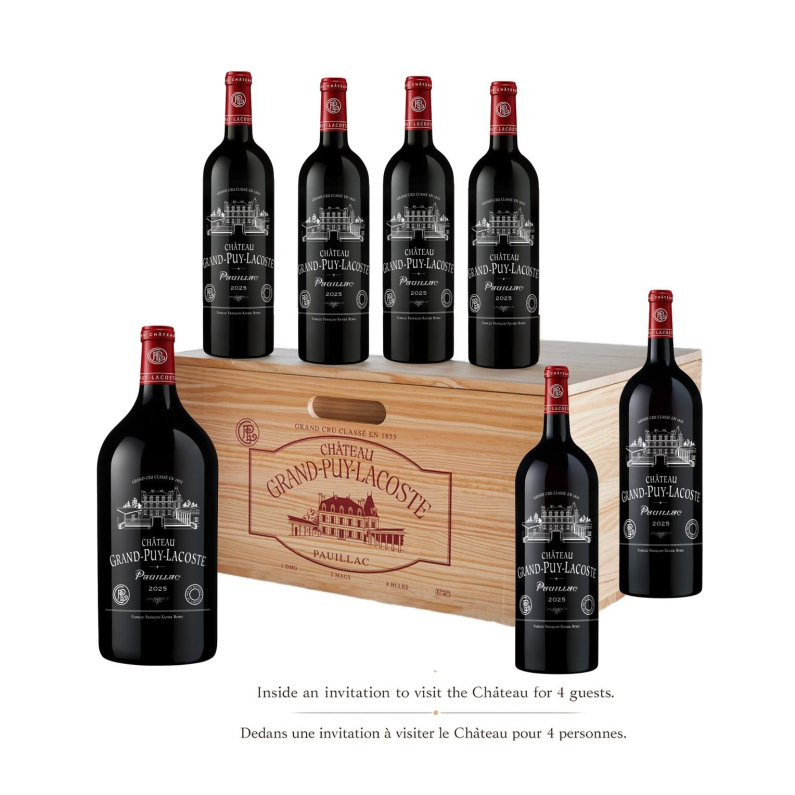
2025 Château Grand-Puy-Lacoste Variation Case
De specificaties zoals vermeld bij de wijn (o.a. wijnjaar) en in de titel zijn leidend en er kunnen geen rechten worden ontleend aan de afbeelding die wordt getoond. Lees meer in onze Frequenty asked questions
- Cellar wine - 6 more years to mature
- Serve at 16-18°C
- Perfect with Rundvlees
Available as of Mar 1, 2028
Ordering in bulk? Log in to request a quote
Out of Stock
Currently unavailable
Backorder possible
Expected in the first half of 2028
- Cellar wine - 6 more years to mature
- Serve at 16-18°C
- Perfect with Rundvlees
Available as of Mar 1, 2028
How does this wine taste?
How full and heavy the wine feels in your mouth, like the difference between skimmed milk and cream. More alcohol, sugar and oak ageing make a wine fuller.
The drying, grippy feel on your gums and tongue, as with strong tea. It comes from the skins and seeds of black grapes and from oak, and softens with age.
How much sugar you taste, from dry to sweet. Fruity is not the same as sweet: a dry wine can taste of ripe fruit.
How fresh and juicy the wine is: acidity makes your mouth water. High acidity tastes lively and refreshing, low acidity soft and round.
What we taste What you taste Click a taste for what it means
The bars follow how sommeliers taste (WSET): body, tannin, sweetness and acidity, each from low to high.
Body: full-bodied. Like most red wines from ; 13% alcohol.
Tannin: firm. Aged in oak.
Sweetness: dry. Red wine from is almost always dry.
Acidity: medium. The temperate climate of Médoc.
Nothing noted for this wine yet. What do you smell, and how long does the taste linger?
Have you tasted this wine?
Save your rating and notes.
Save your rating and notes.
Have you tasted this wine?
Log in to save your tasting note.
Log in to save your tasting note.
Log inA FIRST DELIVERY SPRING 2028
The 2025 Château Grand-Puy-Lacoste is one of the absolute top wines of Pauillac and is considered by many critics to be one of the strongest vintages the château has ever produced. This classic Pauillac impressively combines power, precision, and refinement. For collectors, there is also the exclusive Variation Case, a special edition offered specifically for En Primeur that makes this historic vintage even more attractive.
Winery Château Grand-Puy-Lacoste
Château Grand-Puy-Lacoste is one of the most respected Cinquième Grand Cru Classé estates in Pauillac. The château boasts 90 hectares surrounding the estate, of which 63 hectares are planted with vines on one of the most consistent gravel ridges in the appellation. The Borie family has been at the helm since 1978, and under the leadership of François-Xavier Borie, Grand-Puy-Lacoste has built a reputation as one of the most reliable and classic Pauillacs of Bordeaux.
Moreover, the 2025 vintage marks an important moment in the history of the château: it is the first harvest to be vinified entirely in the new gravity cellar, an investment that allows for greater precision during vinification and plot selection.
One of the great GPL vintages
According to the château itself, 2025 is one of the greatest vintages of Grand-Puy-Lacoste. The wine contains 76% Cabernet Sauvignon, a proportion comparable to some of the most successful editions in the estate's history. The yield was only 30 hl/ha, significantly lower than average, which resulted in extra concentration and depth.
Moreover, it is striking that the introductory price for private customers is significantly lower than for iconic vintages such as 2005, 2009, 2010, 2015, 2016, 2018, 2020, and 2022 during their original En Primeur campaigns. As a result, 2025 is viewed by many enthusiasts as one of the most attractive buying opportunities of recent years.
The wine and blend
The blend consists of 76% Cabernet Sauvignon and 24% Merlot. The average age of the vines is over forty years. The high presence of Cabernet Sauvignon gives the wine its classic Pauillac character, with structure, freshness, and aging potential as its key features.
Terroir and vintage 2025
The vineyards are situated on deep Garonne gravel soils, a terroir perfectly suited for Cabernet Sauvignon. After a dry winter and a healthy spring, the growing season proceeded under excellent conditions. The low yields resulted in concentrated grapes with great aromatic precision.
The château describes the wine as a perfect reflection of the terroir: refined, harmonious, and with a combination of depth, elegance, and freshness. Blue fruit, pronounced minerality, and a long, energetic finish form the core of the profile.
Vinification and aging
The grapes were harvested between September 4 and 18, 2025. Thanks to the new gravity cellar, each plot could be processed individually with maximum precision. Fermentation took place in specially designed stainless steel tanks, followed by aging for approximately 17 months in French oak barrels, 65% of which were new wood.
Color, smell and taste
Deep ruby red in color. On the nose, aromas of cassis, blackcurrants, blackberries, and raspberries, complemented by graphite, cedarwood, pencil shavings, and subtle floral nuances. As the wine opens up, additional layers of mineral notes and refined spices emerge.
On the palate, the wine is medium to full-bodied with impressive precision. The tannins are refined, grainy, and perfectly integrated. The combination of dark fruit, lively acidity, and distinct mineral tension creates a classic Pauillac with plenty of energy. The finish is exceptionally long, harmonious, and complex.
The exclusive Variation Case
For En Primeur 2025, Château Grand-Puy-Lacoste is once again releasing its highly prized Variation Case. This exclusive case contains the equivalent of twelve bottles, distributed across different sizes: 4 bottles of 75 cl, 2 magnums, and 1 double magnum. This allows the same wine to be tracked over many years at different times and in different stages of aging.
What makes this edition extra special is that it is the first Variation Case of the first vintage to be produced entirely in the new gravity cellar. In addition, the buyer of every Variation Case receives an exclusive invitation for four people for a private visit to Château Grand-Puy-Lacoste, including a guided tour and an exclusive tasting at the château. The invitation has no expiration date and remains valid for as long as the château exists.
Summary of professional reviews
The 2025 Château Grand-Puy-Lacoste is among the most highly regarded Pauillacs of the vintage. Yohan Castaing (The Wine Advocate, 95-97 points) praises the classic style, the refined structure, and the precision that is even more evident thanks to the new cellar. Neal Martin (94-96 points) calls it one of the most refined GPLs he has tasted at a young age and particularly praises the harmony and the impressive length. Jacobo García Andrade awards 96-97 points and emphasizes the precision, freshness, and exemplary integration of the tannins. The general consensus is that 2025 can effortlessly hold its own against the château's great modern vintages.
Character
The wine
Origin
Bottle
Wine features
Parker
The Wine Advocate
RP (95-97)
Reviewed by:
Yohan Castaing
Release Price:
NA
Drink Date:
N/A
The 2025 Grand-Puy-Lacoste reveals a classic, refined bouquet of cassis, dark berries, cedar and lead pencil, with discreet floral nuances. Medium- to full-bodied, structured and precise, it’s built around a well-defined core of fruit framed by finely grained, youthful, filigreed tannins with a tensile profile. Less demonstrative than some of its peers in Pauillac, it privileges balance and typicity over sheer power, concluding with a long, elegant and mineral finish. Produced from a blend of 76% Cabernet Sauvignon and 24% Merlot, this is the first vintage vinified in the estate’s new gravity-fed cellar, enabling more precise parcel selection—an evolution that appears to reinforce the wine’s precision and coherence.
Château Grand-Puy-Lacoste covers some 90 hectares on one of Pauillac’s most coherent gravel rises, where Cabernet Sauvignon dominates, supported by Merlot. The Borie family directs the estate with a steady hand, favoring continuity and incremental improvement over stylistic shifts.
Viticulture remains traditional, with straightforward vineyard work and picking decisions taken parcel by parcel. Recent investment centers on a new gravity-fed winery, which handles fruit more gently and sharpens precision. It enables more precise control of extractions and a more detailed, parcel-by-parcel vinification. In the cellar, fermentations proceed without artifice, followed by élevage in barrels, with a measured proportion of new oak and regular rackings.
The range centers on the grand vin. Lacoste-Borie is not a classic second wine but derives from parcels planted on different soils, cultivated and vinified separately, yielding a distinct expression rather than a conventional second wine.
In 2025, Grand-Puy-Lacoste delivers what it set out to deliver: a classic Pauillac, structured and direct. The style holds its line but gains in detail and control thanks to the new winery. Tannins show better integration, the fruit reads more clearly, and the wine keeps its linear, age-worthy frame.
Published: Apr 30, 2026
Lorem ipsum dolor sit amet, consectetur adipiscing elit. Sed do eiusmod tempor incididunt ut labore et dolore magna aliqua...
James Suckling
Score: 96-97
Excellent GPL, medium- to full-bodied with a great expression of dark fruit that is evenly distributed. It’s fresh and precise with grainy, integrated tannins that should only integrate more. A blend of 76% cabernet sauvignon and 24% merlot.
Jacobo García Andrade
Senior Editor
Lorem ipsum dolor sit amet, consectetur adipiscing elit. Sed do eiusmod tempor incididunt ut labore et dolore magna aliqua...
Vinous
The 2025 Grand-Puy-Lacoste is the first to be made in the new gravity-fed winery. It was picked between September 4 and 18 at 30 hl/ha, much lower than normal, with a high percentage of Cabernet Sauvignon (76%). Matured in 65% new oak, it has a perfumed bouquet with blackberry and raspberry fruit, touches of graphite emerging with aeration, beautifully defined. The palate is medium-bodied with edgy tannins. Definitely one of the most refined GPLs that I have tasted at this stage, very harmonious, complex and engaging. Superb persistence on the finish, this is a complete Pauillac that is going to give immense pleasure.- By Neal Martin on May 2026
(94-96)
Drinking Window
2032 - 2060
Lorem ipsum dolor sit amet, consectetur adipiscing elit. Sed do eiusmod tempor incididunt ut labore et dolore magna aliqua...
Exclusive Content
Sign in to unlock professional wine reviews from world-renowned critics
- Cinquième Grand Cru Classé en 1855
The Grand-Puy-Lacoste family history archives date back to the 16th century. The first recorded owner was M. de Guiraud, a member of the Bordeaux parliament. The estate usually passed down female lines of inheritance and was the dowry in successive marriages. One of M. de Guiraud's daughters married M. de Jehan, another MP. Their son, Bertrand de Jehan, had a daughter who inherited the estate and married M. d'Issac. Traditionally, an owner's name was appended to a place name (such as Grand-Puy), but the hereditary daughters took their husbands' names upon marriage, which explains the numerous name changes by which Grand-Puy is known. When d'Issac's daughter married a Bordeaux lawyer named Saint Guirons, the property became "Grand-Puy Saint-Guirons", it was their daughter, Marie-Jeanne de Saint Guirons, who married François Lacoste. With this marriage in the 19th century, the property took on the name of Lacoste. Still, the name Saint-Guirons remained a reminder of the bond between the two families and of the estate's heritage, so for a time the wines were labeled 'Saint Guirons-Lacoste'. François Lacoste and Marie-Jeanne de Saint Guirons had three children, and after the death of the couple, their son Pierre-Frédéric Lacoste inherited the property in 1844. Pierre-Frédéric Lacoste was an enterprising man who was very devoted to his estate. Like François-Xavier Borie the next century, Lacoste focused on quality and improving the wine's reputation. In 1855 he rebuilt the château, and that same year Grand-Puy-Lacoste's status was officially recognized by its inclusion in the official list of Bordeaux's Great Classified Growths.
The history of Grand-Puy-Lacoste is fascinating in many ways. It is a family saga dating back to the 16th century. The name Grand-Puy, already mentioned in documents from the Middle Ages, comes from the old term "puy" which means "little knoll, small height". The vineyard lives up to its name and is located on outcrops with a terroir similar to that of the first vegetation of the Médoc. From the 16th century, the property remained linked to a single family from generation to generation, in a direct line through marriage until 1920, before being linked to another family in 1978: the Borie.
The castle has been owned by the Borie family since 1978. Jean-Eugène Borie's eldest son, François-Xavier, gradually renovated the property in vineyard, cellars and château. The Borie family has a long history of winemaking at the highest level with properties such as Château Haut Batailley and Château Ducru-Beaucaillou, respectively 5th and 2nd Grand Cru Classé. François-Xavier is now assisted by his daughter Emeline, who is responsible for the château's PR. With the purchase of Grand Puy Lacoste, the Borie family has awakened a "sleeping beauty". Now the domain has great prestige and is at the top of the classification in Pauillac.
Grand-Puy-Lacoste is located in the Pauillac terroir, one of the six common appellations of the Médoc along the left bank of the Gironde. The Pauillac appellation is limited to the municipal district of 2,274 hectares. It boasts 18 properties classified in 1855 (about 85% of the appellation's total production). The commune is separated from Saint-Estèphe in the north by the marshy area of Breuil and from Saint-Julien in the south by the hollow formed by the stream Juillac. The Grand-Puy plateau is located to the west of the village, above the hamlet of Bages. This offshoot of the grounds (called a "puy" in the old local dialect)
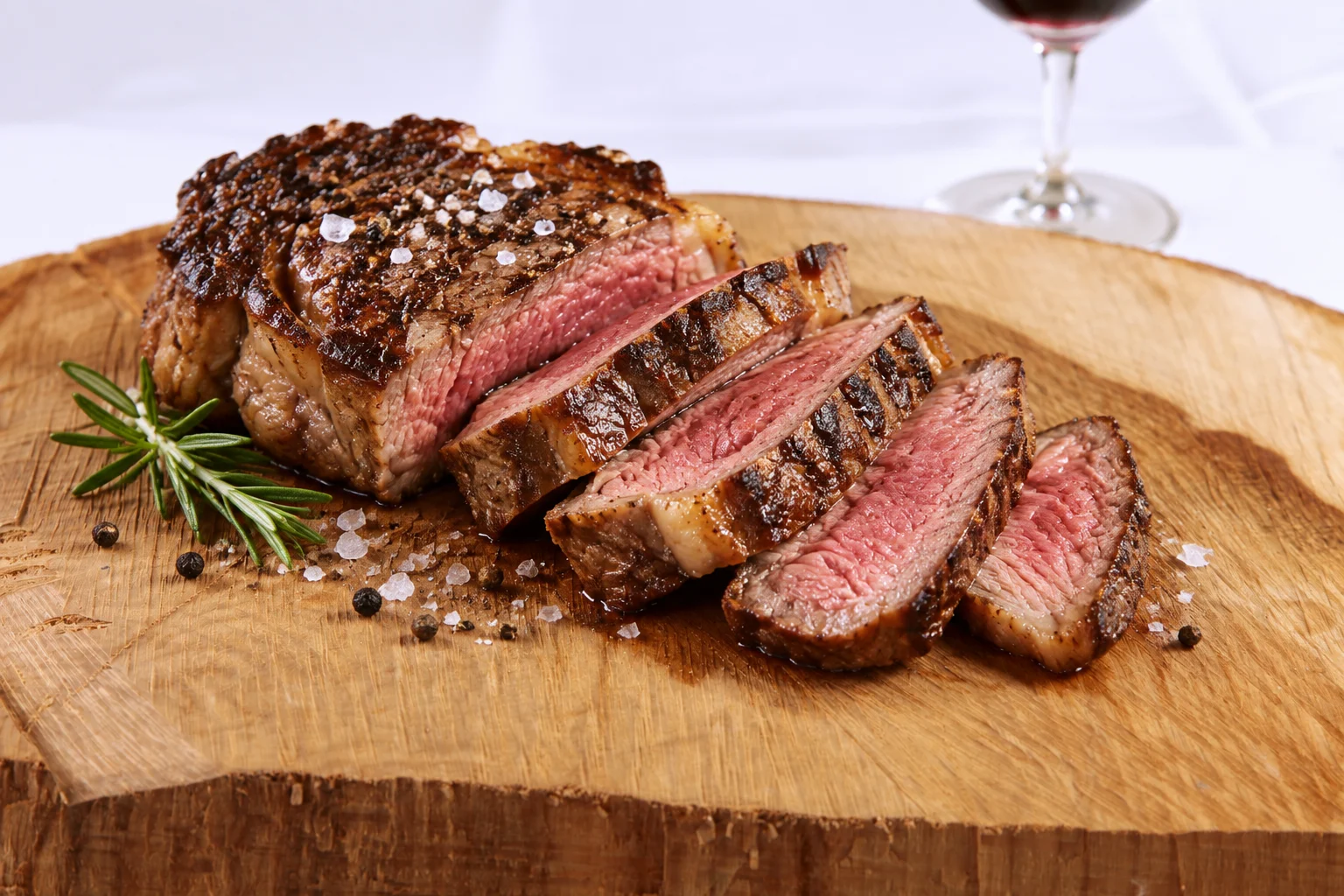
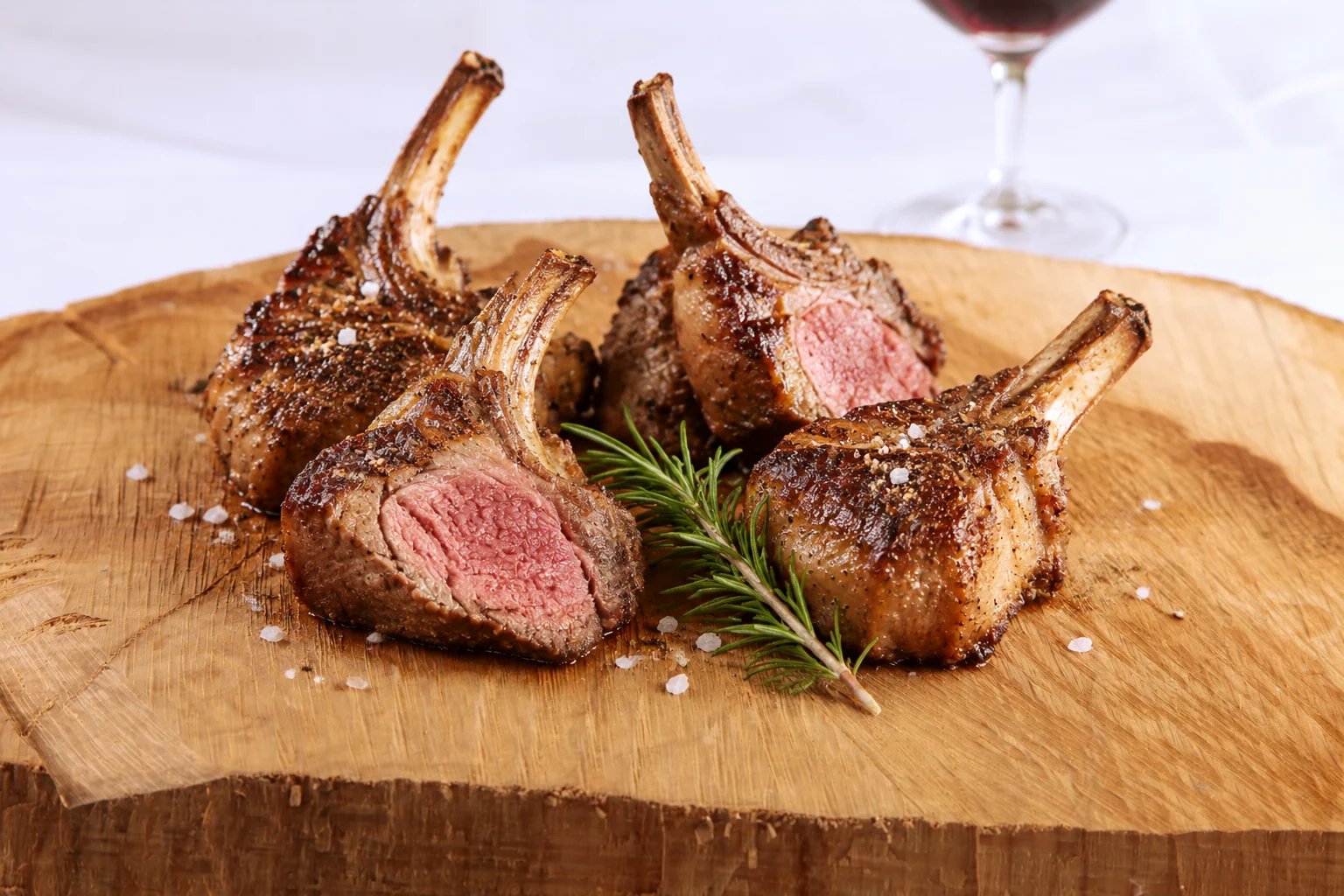
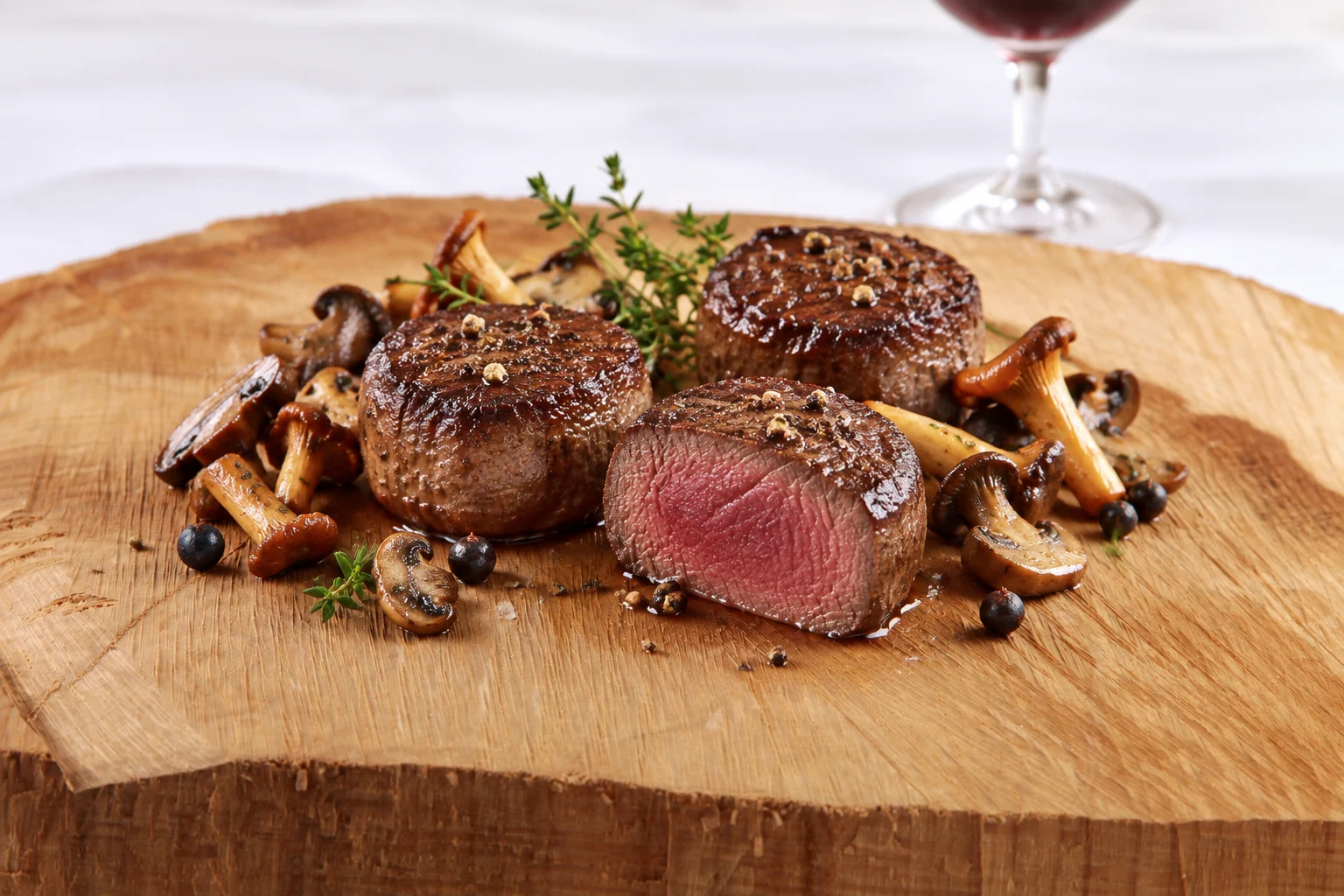
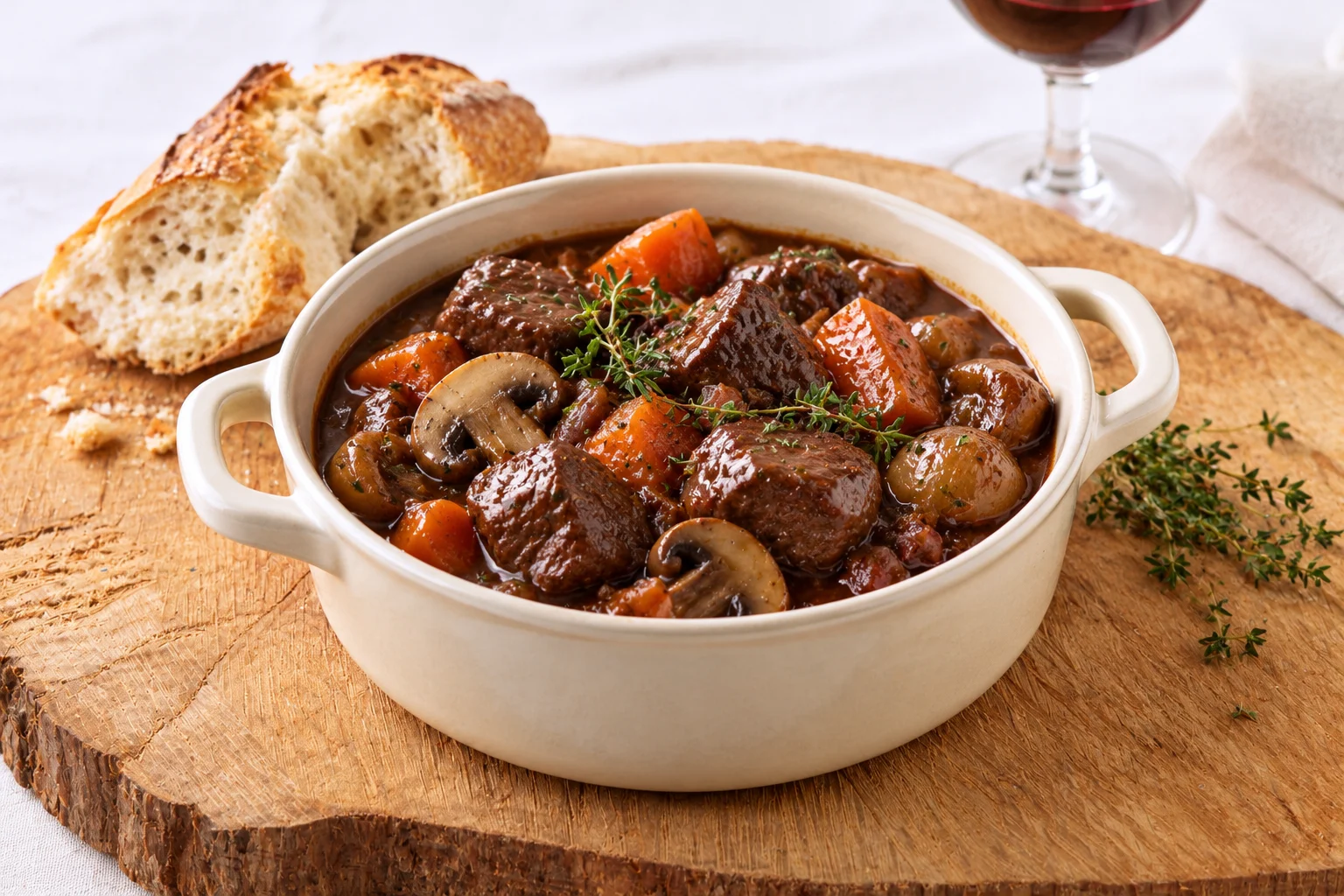
Deze Grand-Puy-Lacoste 2025 toont een verfijnd palet van cassis, zwarte bessen en bramen met ceder, grafiet en subtiele bloemige tonen, medium tot vol van body met frisse zuren, fijne korrelige tannines en een lange minerale afdronk. Dankzij die structuur en zuurgraad snijdt hij door rijke smaken en vetten van rund, lam en wild en vult hij gestoofde gerechten aan doordat de tannines en mineraliteit verzadiging en lengte geven zonder te overheersen. Kies voor gegrilde entrecote of côte de boeuf met gereduceerde jus, langzaam gegaarde lamsbout met rozemarijn of een wildstoof met jeneverbessen en paddenstoelen om de complexe fruit- en houttonen optimaal tot hun recht te laten komen.
Choose a category to discover dishes that pair well with this wine.
Do you already have a dish in mind?
Let Sommy find wines to pair with your meal.
Discover Wine Trivia
Sign in to unlock fascinating facts about this wine and expand your knowledge.
Sign In

+ 2 more attachments