

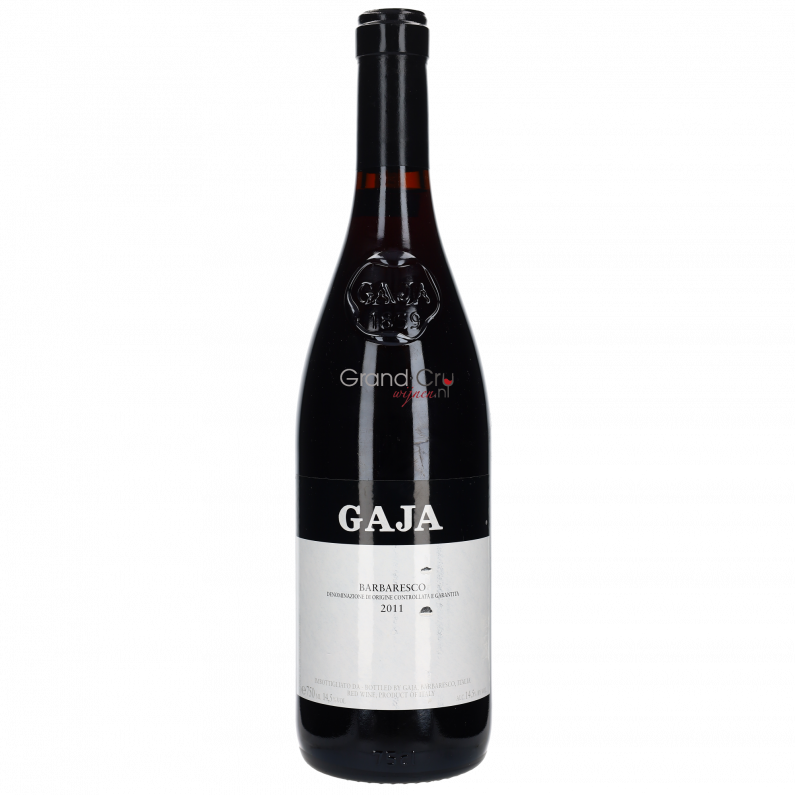
2011 Gaja Barbaresco
| Type of Wine | |
|---|---|
| Country | Italy |
| Region | |
| Appellation | |
| Winery | |
| Vintage | 2011 |
| Grape | |
| Content (Alc) | 0.75 ltr (14%) |
| Drink window | 2017 - 2035 |
Ordering in bulk? Log in to request a quote
Out of Stock
Currently unavailable
Notify me when this product is back in stock
Notities
Foto
Proefnotities
Heb je deze wijn geproefd?
Bewaar je beoordeling en aantekeningen.
Bewaar je beoordeling en aantekeningen.
Heb je deze wijn geproefd?
Log in om je proefnotitie op te slaan.
Log in om je proefnotitie op te slaan.
InloggenHoe wil je je wijn beoordelen?
Max 5 MB. JPG, PNG, WebP.
Hoe smaakt het?
Klik op wat het beste past. Alles is optioneel.
Welke geuren en smaken herken je?
Klik op alles wat je herkent. Dit is optioneel.
Uiterlijk
Neus
Aroma's (neus)
Smaak
Smaken (mond)
Afdronk
Wijngegevens
Automatisch ingevuld vanuit productgegevens.
Persoonlijke gegevens
Gaja Winery
Founded in 1859 in Barbaresco, Gaja is considered one of Italy's most influential estates. Its style focuses on precision, terroir expression, and extended aging. In its vineyards, it increasingly adheres to sustainable and biodynamic principles, focusing on healthy soils and balanced growth. In its cellars, Gaja combines traditional Piedmontese methods with modern insights, aiming for purity, structure, and consistency over time.
More information about this winery can be found under the Winery tab.
Region, climate and location
This Barbaresco comes from the Langhe region of Piedmont, where the vineyards are located around the villages of Barbaresco and Treiso. The region is characterized by a hilly landscape with wide variations in exposure and altitude. The 2011 vintage experienced a warm growing season, resulting in wines that are accessible early yet retain sufficient freshness and balance. These conditions fostered ripe fruit and aromatic expression without excessive heaviness.
Barbaresco within the domain
The Barbaresco de Gaja is a blend of grapes from various vineyards within the appellation. This wine reflects the terroir and vintage clearly, without the extreme concentration of single-vineyard bottlings. In 2011, this resulted in an elegant and open style, with a clear focus on aroma, finesse, and drinkability.
Vineyards
The grapes come from multiple plots with chalky soils and clay, which provides structure and aromatic complexity. By using different locations, a balance can be achieved between ripeness, freshness, and tannin structure. This makes the Barbaresco a harmonious and consistent expression of the estate.
Grape varieties and composition
The wine is made entirely from Nebbiolo. Selection focuses on grapes with ripe tannins and sufficient acidity, appropriate for the appellation's style. In 2011, the emphasis is on softness and aromatic clarity, while retaining structure for further development.
Harvest
The harvest took place in a warm year, allowing the grapes to reach good phenolic ripeness. Careful timing preserved the acidity and prevented overripeness. This resulted in grapes with ripe fruit and refined tannins.
Vinification
Vinification was carried out with a focus on gentle extraction, in keeping with the vintage's character. Fermentation and maceration were aimed at preserving aromatic expression and developing a supple structure. This approach aligns with the house's philosophy of prioritizing terroir and vintage.
Maturation
The wine was aged in a combination of large wooden barrels and smaller barrels, tailored to balance and integration. This aging supports the structure and refines the tannins without overpowering the fruit. The result is a wine that is both accessible and aging well.
Color, smell and taste
The color is bright ruby red. The aroma reveals notes of crushed flowers, red fruit, tobacco, and sweet spices. On the palate, the wine is smooth and silky, with a medium body and elegant structure. Flavors of cherry, red berry fruit, and floral accents create a refined and open style, with ample freshness and length.
Development and drinking window
This Barbaresco is already quite approachable, yet possesses sufficient structure to develop further. As the wine ages, its complexity will increase, and tertiary notes will further unfold. The drinking window is from approximately 2017 to 2035.
Summary of professional reviews
Antonio Galloni awarded the 2011 Barbaresco 94 points, praising its open aromas, silky structure, and floral complexity, with an accessible yet refined style. Monica Larner, on behalf of The Wine Advocate, awarded 93 points, highlighting its finesse, focus, and remarkable vibrancy, despite the warm character of the vintage. Both reviewers consider this wine a balanced and expressive Barbaresco with a wide drinking window.
The full review texts can be found in the Professional Reviews tab.
If available, you'll find the official fact sheet and additional information about this fine wine in the "Attachments" tab. We'll automatically send you this information when you order this wine. The wine is stored in our climate-controlled Wine Warehouse, and if you pick it up, you'll often receive a nice discount. You'll see your discount immediately when you select "Pick up" at the checkout page. We're located in Dordrecht, right next to the A16 motorway, with ample parking. Click here for our address.
You can read the full wine reviews from Parker, Suckling, Vinous, and Wine Spectator, among others. Need advice on finding the perfect wine to pair with your dish? Click here for our exclusive Sommelier. Free for Grand Cru customers.
Wine and food pairings
- Roasted guinea fowl with thyme and citrus peel, complementing the floral notes and freshness of the wine.
- Veal entrecote with a light mushroom sauce, matching the supple tannins and elegant structure.
- Risotto with fennel and Parmesan, which enhances the aromatic clarity and tension.
- Braised rabbit with rosemary and carrot, which complements the medium weight of the wine nicely.
- Grilled beetroot with lentils and soft herbs, respecting the earthy and floral elements.
| Type of Wine | Red |
|---|---|
| Country | Italy |
| Region | Piemonte |
| Appellation | Barbaresco |
| Icons | Icon Italy |
| Winery | Gaja |
| Grape | Nebbiolo |
| Biological certified | No |
| Natural wine | No |
| Vegan | No |
| Vintage | 2011 |
| Drinking as of | 2017 |
| Drinking till | 2035 |
| Alcohol % | 14 |
| Alcohol free/low | No |
| Content | 0.75 ltr |
| Oak aging | Yes |
| Sparkling | No |
| Dessert wine | No |
| Closure | Cork |
| Parker rating | 93 |
| Vinous rating | 94 |
| Tasting Profiles | Aards, Complex, Donker fruit, Droog, Fris, Houtgerijpt, Krachtig, Kruidig, Licht zoet, Mineraal, Rijk, Rood fruit, Strak, Tannines, Vol, Wit fruit |
| Drink moments | Barbecue, Iets te vieren, Indruk maken, Lekker luxe, Met vrienden, Open haard, Romantisch, Terras |
| Sommy Pairing Beschrijving | Deze 2011 Gaja Barbaresco toont een elegant profiel van gekneusde bloemen, kersen en rood bessig fruit met tonen van tabak, zoete specerijen en zijdezachte tannines gecombineerd met frisse zuren. Daardoor sluit de wijn prachtig aan bij rundvlees en lam omdat de zuren en tannines vet en eiwit doorsnijden, bij kazen en pasta omdat de florale en specerijachtige tonen de umami van gerijpte kazen en romige sauzen versterken, en bij pizza wanneer die niet te zwaar is of is belegd met paddenstoelen of charcuterie. Extra goede combinaties ontstaan bij gegrild of licht geroosterd vlees, kalfsentrecote met een subtiele paddenstoelensaus, gestoofd of braadgerecht met rozemarijn en bij risotto met venkel en Parmezaan. |
Parker
The Wine Advocate
RP 93
Reviewed by:
Monica Larner
Release Price:
NA
Drink Date:
2017 - 2035
The 2011 Barbaresco opens to a dark garnet color and shows immediate opulence and intensity where its aromas are concerned. There’s an undeniable level of finesse and focus here that goes against all the things you might assume about a warmer vintage like 2011. The mouthfeel is perfectly tempered and smooth with an incredible sense of liveliness and dimension. Fruit is sourced from Gaja’s many vineyard holdings. Drink: 2017-2035.
I have some happy news to report from the exciting world of Angelo Gaja. The estate that was notoriously difficult (if not impossible) to visit for those outside the wine trade is now opening its doors to the public. There is a steep entrance fee, but the scheme makes perfect sense in my option. Any wine lover can make an appointment to tour the estate and sample wine for up to 300 euros a person. The money must be paid to charity as none of the proceeds go to Gaja. If you have a favorite non-profit organization, make a donation in that amount. Once you send receipt of payment to Gaja’s tasting room staff, your visit will be granted. It sounds like a fair exchange to me.
Importer: Terlato Wines International, www.terlatowines.com
Published: Jun 26, 2014
Lorem ipsum dolor sit amet, consectetur adipiscing elit. Sed do eiusmod tempor incididunt ut labore et dolore magna aliqua...
Vinous
94
Drinking Window
2016 - 2033
From: Barbaresco’s Stellar 2011s (Oct 2014)
Crushed flowers, tobacco, sweet spices and red berries lift from the glass in the 2011 Barbaresco. Soft silky and accessible, the Barbaresco is already wonderfully open and expressive, as so many wines are in this vintage. Kirsch, hard candy and floral notes add nuance over time. The style is mid-weight and gracious, with gorgeous aromatic complexity and plenty of brightness, especially within the context of the year.
- By Antonio Galloni on July 2014
Gaja's 2011s are great lessons in terroir. The Barbaresco shows the wisdom of being able to blend fruit across multiple sites, the Costa Russi is pliant but not quite profound, while the Sorì Tildìn and Sorì San Lorenzo ooze with the personality that only the world's greatest sites possess.
Lorem ipsum dolor sit amet, consectetur adipiscing elit. Sed do eiusmod tempor incididunt ut labore et dolore magna aliqua...
Exclusive Content
Sign in to unlock professional wine reviews from world-renowned critics
The history of winery Gaja starts in 1859, the year in which Giovanni Gaja, a local grape grower in Barbaresco, Piemonte, founded a wine company under his own name. A generation later, it is Angelo, grandfather of the current owner, who continues to make wine with the same determination as his father. He is supported in this by Clotilde Rey with whom he marries in 1905. They teach their scion Giovanni named after his grandfather so that as a winemaker you should not make any concessions; nothing should be at the expense of the quality of the wine.
In 1961 Giovannis son Angelo works in the family business. After graduating as an economist from the University of Turin and graduating from the School of Viticulture & Oenology in Alba, the young Angelo left abroad for an internship at wine farms in Bordeaux, Burgundy, along the Rin and in California. Full of fresh ideas, he had now returned to his native Piemonte. When Angelo Gaja took over his parents' company in 1970, he asked his old classmate and winemaker Guido Rivella to assist him. Together they implement a number of revolutionary changes for the region. For example, they sometimes reduce yields per hectare by up to half the number of liters allowed, they experiment with vinification methods, the planting of new - both red and white - grape varieties and pioneering ripening techniques. The results are astonishing and Gaja conquers the world with his beautiful Barbaresco's - the company's flagship.
The nebbiolo grapes for the Barbaresco of Gaja traditionally came from different vineyards. Angelos' father, grandfather and his father did just that before. Although young Angelo would not end this tradition, he launched a new line of Barbaresco's from a single vineyard. Interest in these experimental single vinyard wines became more and more popular. As a proponent of a dynamic, purely quality-oriented wine culture, the brilliant winemaker decides from 1996 to completely break with what he considers to be a conservative and restrictive Italian designation of origin. Only his traditional Barbaresco is still on the market as a prestigious DOCG. He deliberately 'declassifies' all other red single vineyard wines into regional Langhe Nebbiolo DOC. These are the Sorì San Lorenzo, the Sorì Tildìn and the Costa Russi. Gajas Barolo Sperss also underwent the same name change. With the exception of the Dagromis Barolo DOCG, Sito Moresco and Conteisa de Langhe also bear DOC. Langhe DOC is also on the label of his white toppers from Piemonte, the Rossj-Bass, Alteni di Brassica and Gaia & Rey. After all, for Gaja the abbreviation does not guarantee good quality of a wine but the name of the producer.
Food Pairings
Deze 2011 Gaja Barbaresco toont een elegant profiel van gekneusde bloemen, kersen en rood bessig fruit met tonen van tabak, zoete specerijen en zijdezachte tannines gecombineerd met frisse zuren. Daardoor sluit de wijn prachtig aan bij rundvlees en lam omdat de zuren en tannines vet en eiwit doorsnijden, bij kazen en pasta omdat de florale en specerijachtige tonen de umami van gerijpte kazen en romige sauzen versterken, en bij pizza wanneer die niet te zwaar is of is belegd met paddenstoelen of charcuterie. Extra goede combinaties ontstaan bij gegrild of licht geroosterd vlees, kalfsentrecote met een subtiele paddenstoelensaus, gestoofd of braadgerecht met rozemarijn en bij risotto met venkel en Parmezaan.
Click on a category to discover delicious recipes that pair perfectly with this wine.
Do you already have a dish in mind?
Let our AI sommelier help you find the ideal wine for your dish
Start the Sommy Wine Advice ToolDiscover Wine Trivia
Sign in to unlock fascinating facts about this wine and expand your knowledge.
Sign In