
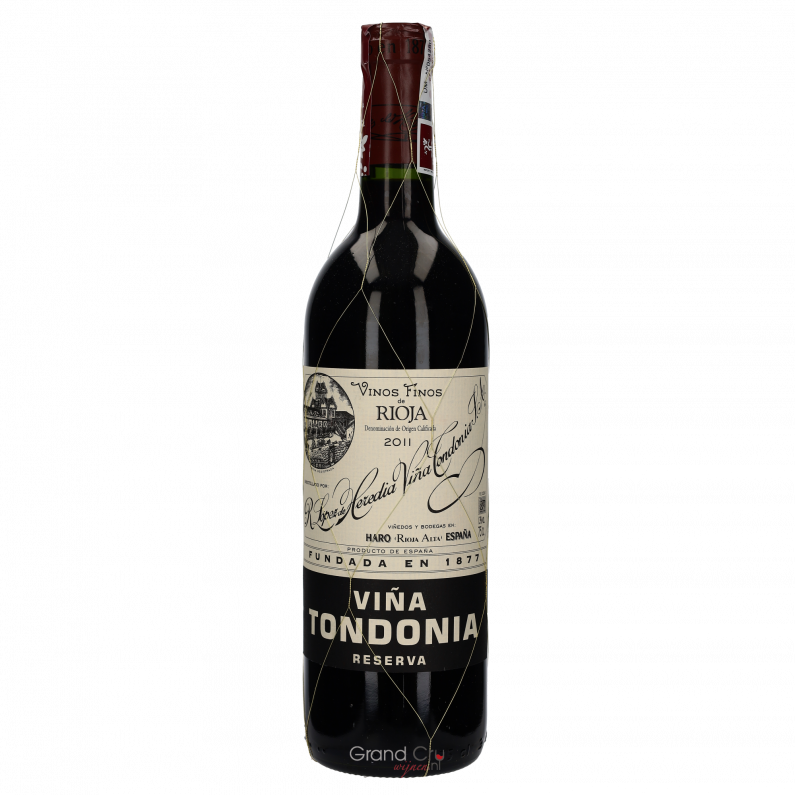
2011 Lopez de Heredia Vina Tondonia Reserva
| Type of Wine | |
|---|---|
| Country | Spain |
| Region | |
| Appellation | Rioja Alta |
| Winery | |
| Vintage | 2011 |
| Grape | , , , |
| Content (Alc) | 0.75 ltr (14%) |
| Drink window | 2022 - 2032 |
| Available as of | Nov 2, 2025 |
- Buy 6 for 39.95 33.02 each and save 7%
In stock
15 items available
Description
Lopez de Heredia needs little introduction. The vineyards are located on the right bank of the Ebro River in Haro (Rioja Alta). The Tondonia is still made traditionally, with the must fermented with the skins in large 240-liter oak barrels for approximately seven days. The second fermentation takes place in Bordeaux barrels and is relatively long (up to six months). The wine then matures for over six years in used French oak, followed by several more years of bottle aging before being released. The Vina Tondonia Reserve is a blend of 70% Tempranillo, 20% Garnacha, and 10% Mazuelo and Graciano. Tondonia produces a truly authentic, vintage Rioja, and its style is truly unique. After the wine is exposed to ample oxygen, a beautiful palette of aromas unfolds, with notes of cherry, leather, and cigar emerging as the first notes. The wine is medium bodied and has the typical tondonia oxidative (pleasant) tone and the taste is fine and balanced.
What makes Tondonia unique is the very long aging in old oak (they employ their own tonneliers) before being released after several years of bottle aging. These wines can age for a very long time and are completely different from modern French oak-aged wines. The 2011 vintage was rated EXCELLENT by the Appellation.
94/100 Parker
95/100 James Suckling
Specifications
| Available as of | Nov 2, 2025 |
|---|---|
| Packing information | Box |
| Type of Wine | Red |
| Country | Spain |
| Region | Rioja |
| Appellation | Rioja Alta |
| Winery | Lopez De Heredia |
| Grape | Garnacha, Graciano, Mazuelo, Tempranillo |
| Biological certified | No |
| Natural wine | No |
| Vegan | No |
| Vintage | 2011 |
| Drinking as of | 2022 |
| Drinking till | 2032 |
| Alcohol % | 14 |
| Alcohol free/low | No |
| Content | 0.75 ltr |
| Oak aging | Yes |
| Sparkling | No |
| Dessert wine | No |
| Closure | Cork |
| Promotion | Tier Price |
| Parker rating | 94 |
| James Suckling rating | 95 |
| Vinous rating | 96 |
| Tasting Profiles | Aards, Droog, Houtgerijpt, Krachtig, Kruidig, Rood fruit, Soepel, Vol |
| Drink moments | Barbecue, Cadeau!, Met vrienden, Open haard, Romantisch |
Professional Reviews
Parker
Rating
94
Release Price
$60
Drink Date
2022 - 2029
Reviewed by
Luis Gutiérrez
Issue Date
14th Jul 2022
Source
July 2022 Week 2, The Wine Advocate
The 2011 Viña Tondonia Reserva is darker and shows riper fruit, a rounder palate and some dusty tannins. A year of ripeness, concentration and tannin, the wine is powerful with the finesse of Tondonia. Tasting this next to the textbook 2010 Tondonia revealed how this has more muscle and a wider back and the 2010 epitomizes the finesse and elegance. 270,000 bottles produced. It was bottled in May 2019.
I tasted up to three vintages of the same wine as it has been some time since I tasted them, and I also sampled the forthcoming vintages to be released in early 2023. The next vintage of Gran Reserva will be 2004, when they produced all three wines (the rosé was not produced, of course, it was a year in the hiatus between 2000 and 2008). 2005, 2007, 2010, 2011 and perhaps 2013 (for a sentimental reason, when their father died) will also be Gran Reserva vintages. What I tasted made sense with the character of each vintage—brilliant 2010s; a warm and more evolved 2011; a very good 2012; an atypical and challenging 2013; a cool and balanced 2014; and a warmer and riper 2015. As a bonus track, I tasted (and swallowed) the 2004 Viña Tondonia Gran Reserva, and I can tell you I cannot wait for the wine to be released in 2024...
Lorem ipsum dolor sit amet, consectetur adipiscing elit. Sed do eiusmod tempor incididunt ut labore et dolore magna aliqua...
James Suckling
Lorem ipsum dolor sit amet, consectetur adipiscing elit. Sed do eiusmod tempor incididunt ut labore et dolore magna aliqua...
Vinous
No written review available.
Exclusive Content
Sign in to unlock professional wine reviews from world-renowned critics
Wijnhuis
López de Heredia stands as a consistent reference within Rioja. The family estate has worked since 1877 with a focus on long ageing, strict selection and controlled cellar methods. Every wine results from patience and experience. This approach delivers tension, clarity and structure.
López de Heredia winery in Rioja
In the 19th century, French merchants travelled through the region to find grapes for their own production. Don Rafael López de Heredia y Landeta took over their vineyards and recognised the potential of the area. He saw that the climate and the soil offered ideal conditions for quality wine. In 1877 he founded the winery in Haro. The estate grew through consistent care for each vineyard. This mindset remains visible in all cuvées. The wines belong to the leading wines of Rioja.
López de Heredia Viña Tondonia is the oldest winery in Haro and one of the first four producers in La Rioja. Strategic locations, strong vineyard parcels and fitting grape varieties result in wines with a clear profile. These wines remain important references within Spanish wine culture.
The most famous vineyard is Tondonia. It lies along the Ebro and spans around one hundred hectares. The name refers to the river bend where the vineyard sits. The estate also owns Viña Cubillo, Viña Bosconia and Viña Gravonia in Rioja Alta. Each parcel contributes fruit with its own character.
López de Heredia vineyards and grape varieties
Vineyards around Haro combine clay, limestone and river deposits. Summers stay warm with cool nights. This balance preserves tension in the fruit. Red wines rely on Tempranillo supported by Garnacha, Mazuelo and Graciano. White wines use Viura as the base, complemented by Malvasia. This combination delivers freshness, length and stability.
López de Heredia vinification and ageing
The cellar forms an essential part of the estate. An in-house cooperage maintains every barrel. This ensures full control over wood quality. Fermentation takes place in traditional vats. Ageing occurs in old American oak. Red wines remain three to six years in barrels. White wines follow similar timelines. After bottling, the wines continue ageing for many years in the cellar.
Style of López de Heredia wines
Red wines show a lean structure, soft tannins and bright acidity. Aromas include red fruit, dried herbs and light oak tones. White wines combine fresh acidity with oxidative depth. Rosado stands as a separate style. Viña Tondonia Rosado spends long periods in barrel and bottle and shows notable complexity.
López de Heredia Viña Tondonia and other cuvées
Viña Tondonia Reserva remains a stable reference within Rioja. The fruit comes from the vineyard along the Ebro. Viña Bosconia Reserva gives fuller aromas and warmer tones. Gran Reservas age longer in barrel and bottle. Viña Tondonia Blanco Reserva uses Viura and Malvasia with extended ageing. Blanco Gran Reserva appears only in strong years.
López de Heredia vineyard work
Soil health forms the foundation of the estate. Natural ground cover, manual pruning and careful selection result in healthy fruit. This approach ensures clear expression and stable profiles in all wines.
Some Facts about López de Heredia
The family keeps original documents in which Don Rafael recorded every cellar movement. The cooperage has maintained all barrels for more than a century. Several fermentation vats have stood in the cellar since the 19th century and remain in use. A dedicated room stores labels and capsules from all periods. The estate holds bottles from nearly every vintage since the beginning. Viña Tondonia Rosado once disappeared from the market and returned due to requests from wine lovers.
Lopez de Heredia needs little introduction. The vineyards are located on the right bank of the Ebro River in Haro (Rioja Alta). The Tondonia is still made traditionally, with the must fermented with the skins in large 240-liter oak barrels for approximately seven days. The second fermentation takes place in Bordeaux barrels and is relatively long (up to six months). The wine then matures for over six years in used French oak, followed by several more years of bottle aging before being released. The Vina Tondonia Reserve is a blend of 70% Tempranillo, 20% Garnacha, and 10% Mazuelo and Graciano. Tondonia produces a truly authentic, vintage Rioja, and its style is truly unique. After the wine is exposed to ample oxygen, a beautiful palette of aromas unfolds, with notes of cherry, leather, and cigar emerging as the first notes. The wine is medium bodied and has the typical tondonia oxidative (pleasant) tone and the taste is fine and balanced.
What makes Tondonia unique is the very long aging in old oak (they employ their own tonneliers) before being released after several years of bottle aging. These wines can age for a very long time and are completely different from modern French oak-aged wines. The 2011 vintage was rated EXCELLENT by the Appellation.
94/100 Parker
95/100 James Suckling
| Available as of | Nov 2, 2025 |
|---|---|
| Packing information | Box |
| Type of Wine | Red |
| Country | Spain |
| Region | Rioja |
| Appellation | Rioja Alta |
| Winery | Lopez De Heredia |
| Grape | Garnacha, Graciano, Mazuelo, Tempranillo |
| Biological certified | No |
| Natural wine | No |
| Vegan | No |
| Vintage | 2011 |
| Drinking as of | 2022 |
| Drinking till | 2032 |
| Alcohol % | 14 |
| Alcohol free/low | No |
| Content | 0.75 ltr |
| Oak aging | Yes |
| Sparkling | No |
| Dessert wine | No |
| Closure | Cork |
| Promotion | Tier Price |
| Parker rating | 94 |
| James Suckling rating | 95 |
| Vinous rating | 96 |
| Tasting Profiles | Aards, Droog, Houtgerijpt, Krachtig, Kruidig, Rood fruit, Soepel, Vol |
| Drink moments | Barbecue, Cadeau!, Met vrienden, Open haard, Romantisch |
Parker
Rating
94
Release Price
$60
Drink Date
2022 - 2029
Reviewed by
Luis Gutiérrez
Issue Date
14th Jul 2022
Source
July 2022 Week 2, The Wine Advocate
The 2011 Viña Tondonia Reserva is darker and shows riper fruit, a rounder palate and some dusty tannins. A year of ripeness, concentration and tannin, the wine is powerful with the finesse of Tondonia. Tasting this next to the textbook 2010 Tondonia revealed how this has more muscle and a wider back and the 2010 epitomizes the finesse and elegance. 270,000 bottles produced. It was bottled in May 2019.
I tasted up to three vintages of the same wine as it has been some time since I tasted them, and I also sampled the forthcoming vintages to be released in early 2023. The next vintage of Gran Reserva will be 2004, when they produced all three wines (the rosé was not produced, of course, it was a year in the hiatus between 2000 and 2008). 2005, 2007, 2010, 2011 and perhaps 2013 (for a sentimental reason, when their father died) will also be Gran Reserva vintages. What I tasted made sense with the character of each vintage—brilliant 2010s; a warm and more evolved 2011; a very good 2012; an atypical and challenging 2013; a cool and balanced 2014; and a warmer and riper 2015. As a bonus track, I tasted (and swallowed) the 2004 Viña Tondonia Gran Reserva, and I can tell you I cannot wait for the wine to be released in 2024...
Lorem ipsum dolor sit amet, consectetur adipiscing elit. Sed do eiusmod tempor incididunt ut labore et dolore magna aliqua...
James Suckling
Lorem ipsum dolor sit amet, consectetur adipiscing elit. Sed do eiusmod tempor incididunt ut labore et dolore magna aliqua...
Vinous
No written review available.
Exclusive Content
Sign in to unlock professional wine reviews from world-renowned critics
López de Heredia stands as a consistent reference within Rioja. The family estate has worked since 1877 with a focus on long ageing, strict selection and controlled cellar methods. Every wine results from patience and experience. This approach delivers tension, clarity and structure.
López de Heredia winery in Rioja
In the 19th century, French merchants travelled through the region to find grapes for their own production. Don Rafael López de Heredia y Landeta took over their vineyards and recognised the potential of the area. He saw that the climate and the soil offered ideal conditions for quality wine. In 1877 he founded the winery in Haro. The estate grew through consistent care for each vineyard. This mindset remains visible in all cuvées. The wines belong to the leading wines of Rioja.
López de Heredia Viña Tondonia is the oldest winery in Haro and one of the first four producers in La Rioja. Strategic locations, strong vineyard parcels and fitting grape varieties result in wines with a clear profile. These wines remain important references within Spanish wine culture.
The most famous vineyard is Tondonia. It lies along the Ebro and spans around one hundred hectares. The name refers to the river bend where the vineyard sits. The estate also owns Viña Cubillo, Viña Bosconia and Viña Gravonia in Rioja Alta. Each parcel contributes fruit with its own character.
López de Heredia vineyards and grape varieties
Vineyards around Haro combine clay, limestone and river deposits. Summers stay warm with cool nights. This balance preserves tension in the fruit. Red wines rely on Tempranillo supported by Garnacha, Mazuelo and Graciano. White wines use Viura as the base, complemented by Malvasia. This combination delivers freshness, length and stability.
López de Heredia vinification and ageing
The cellar forms an essential part of the estate. An in-house cooperage maintains every barrel. This ensures full control over wood quality. Fermentation takes place in traditional vats. Ageing occurs in old American oak. Red wines remain three to six years in barrels. White wines follow similar timelines. After bottling, the wines continue ageing for many years in the cellar.
Style of López de Heredia wines
Red wines show a lean structure, soft tannins and bright acidity. Aromas include red fruit, dried herbs and light oak tones. White wines combine fresh acidity with oxidative depth. Rosado stands as a separate style. Viña Tondonia Rosado spends long periods in barrel and bottle and shows notable complexity.
López de Heredia Viña Tondonia and other cuvées
Viña Tondonia Reserva remains a stable reference within Rioja. The fruit comes from the vineyard along the Ebro. Viña Bosconia Reserva gives fuller aromas and warmer tones. Gran Reservas age longer in barrel and bottle. Viña Tondonia Blanco Reserva uses Viura and Malvasia with extended ageing. Blanco Gran Reserva appears only in strong years.
López de Heredia vineyard work
Soil health forms the foundation of the estate. Natural ground cover, manual pruning and careful selection result in healthy fruit. This approach ensures clear expression and stable profiles in all wines.
Some Facts about López de Heredia
The family keeps original documents in which Don Rafael recorded every cellar movement. The cooperage has maintained all barrels for more than a century. Several fermentation vats have stood in the cellar since the 19th century and remain in use. A dedicated room stores labels and capsules from all periods. The estate holds bottles from nearly every vintage since the beginning. Viña Tondonia Rosado once disappeared from the market and returned due to requests from wine lovers.
Wine Trivia
🍷 Enjoyed these wine facts? Share your newfound knowledge with fellow wine enthusiasts!
Discover Wine Trivia
Sign in to unlock fascinating facts about this wine and expand your knowledge.
Sign In